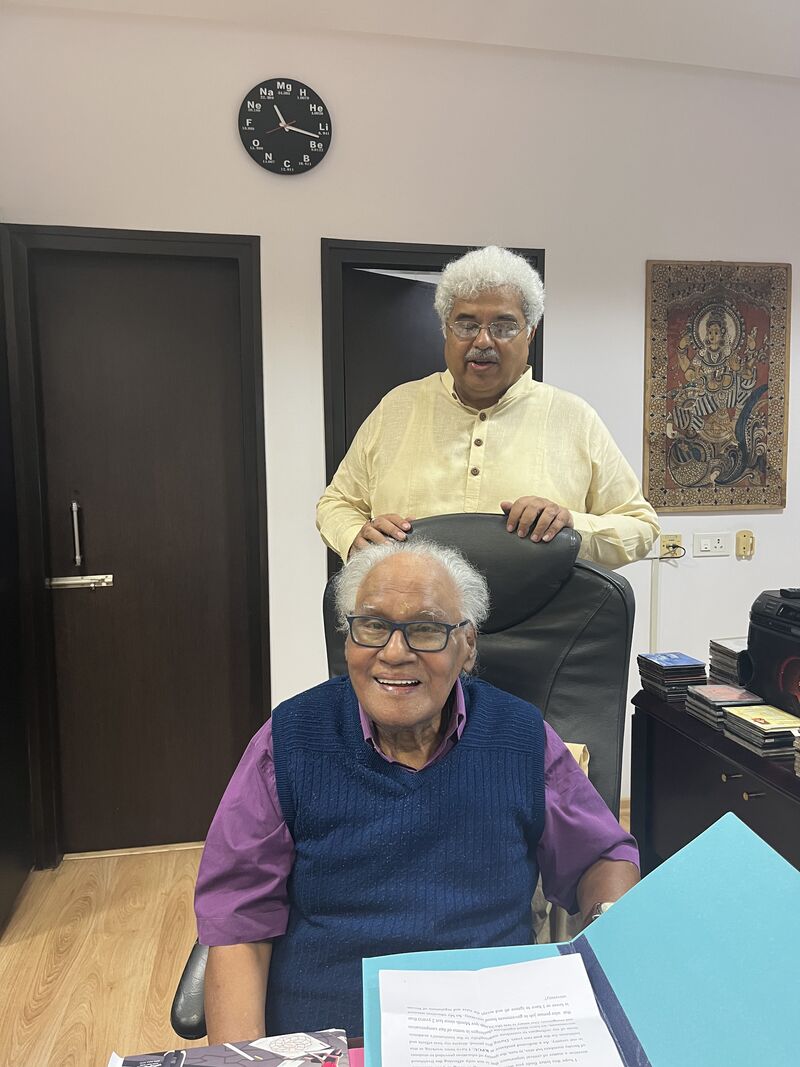
Bharat Ratna CNR Rao
India’s most eminent living scientist
Our best chance for a Nobel in Batteries
Corporates, startups and governments around the world are in a frenzy to come up with a viable battery technology.
Batteries are the missing link in the jigsaw puzzle. Free energy is the promise of the completed jigsaw puzzle. I had the honour to spend a day with Prof CNR Rao and Dr Mrs Indumati Rao and to visit the absolutely beautiful campus of the Jawaharlal Institute Centre for Advanced Scientific Research. Thanks to Jaishri Sanwal Bhatt , I had an opportunity to meet the legend himself as well as talk to the Deans, faculty members, research scientists, startup promoters and students.
I also got to see what an original Bharat Ratna, Padma Vibhushan and Padma Sri look like.
India’s foremost battery expert and a structural chemist like no other – Prof Rao is India’s best chance to win the race for an “affordable, compact, safe, dense, mass manufactured” electrical storage system.
For the uninitiated …
Prof Chintamani Nagesa Ramachandra Rao, (born 30 June 1934), is an Indian chemist who has worked mainly in solid-state and structural chemistry. He has honorary doctorates from 86 universities from around the world and has authored around 1,800 research publications and 58 books. He is described as a scientist who had won all possible awards in his field except the Nobel Prize.
Prof Rao completed his MSc from Banaras Hindu University at age nineteen. He earned a PhD from Purdue University at the age of twenty-four and became a lecturer at IISc. After a transfer to Indian Institute of Technology Kanpur, he returned to IISc, eventually becoming its director from 1984 to 1994.
He founded and works in Jawaharlal Nehru Centre for Advanced Scientific Research and International Centre for Materials Science. The meticulously maintained campus can beat any five star hotel in house keeping.
Prof Rao received scientific awards and honours including the Marlow Medal, Shanti Swarup Bhatnagar Prize for Science and Technology, Hughes Medal, India Science Award, Dan David Prize, Royal Medal, Von Hippel Award, and ENI award. He also received Padma Shri and Padma Vibhushan from the Government of India. On 16 November 2013, the Government of India selected him for Bharat Ratna, the highest civilian award in India, making him the third scientist after C.V. Raman and A. P. J. Abdul Kalam to receive the award.
The ENI award is considered the Nobel prize equivalent in the area of batteries and renewable energy.
The IIT Alumni Council has taken on the target objective of winning the battery race. Council supported initiatives, greenfield startups and strategic acquisitions around the world aspire to challenge Chinese domination in every segment of storage from pacemakers to smartphones and from electric planes to pseudo satellites.
We do look forward to the blessings and support of Prof Rao for the GO battery initiative.