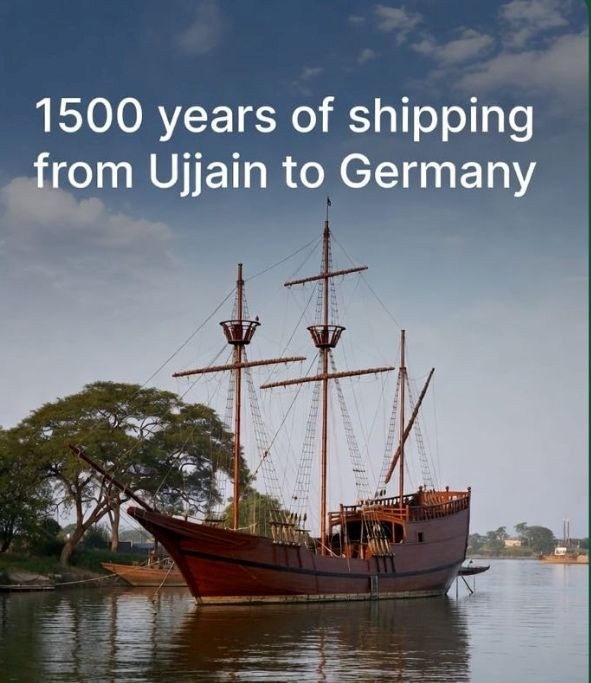
Historians are still relevant Even if geography is history.
History should not be forgotten
IIT Chennai got a mandate to develop a DPR for a inland water route from Jalore in Rajasthan to Bharuch on the west coast. In parallel the IIT Alumni Council task force started studying the river rejuvenation program around the ancient city of Avantika now called Ujjain – the host for Kumbh 2028.
It started with common sense. What the scientists call logical. The Kshipra is a tributary of the Ganges and so Ujjain connects to the east coast at the Sunderbans.
“Nonsense” said the guide at the cremation ghats in Ujjain. Since the times of Vikramaditya (400 CE), ships from Ujjain ferried to Rome through the west coast. We decided to dive deep into this. The start point was to visit the library archives and dig out the only English version on Vikramaditya. The guide was right. The book described in detail how ships went to Europe.
Key Historical References
• Periplus of the Erythraean Sea (1st century CE): explicitly describes the route from “Ozene (Ujjain)” via the Namados River (Narmada) to Barygaza (Bharuch).
• Ptolemy’s Geography (2nd century CE): mentions the same path.
• Archaeological evidence: Roman coins, amphorae, and Indo-Roman trade beads found all along the Narmada valley up to Ujjain.
• Medieval period (Gupta → Paramara → Mughal): continued as the main cotton and opium route to Surat and later Bombay.
Alternative/Secondary Route (less common)
Ujjain → Indore plains → Bagh → Sendhwa → Dhule → Surat
(Used more in the late medieval and British periods when Surat replaced Bharuch as the main port.)
Why Bharuch was the dominant sea outlet for Ujjain
• Deep natural harbor until ~13th century (later silted)
• Direct access to the Gulf of Cambay
• Connected by road and river to Malwa plateau (Ujjain region)
• Customs and warehousing facilities mentioned as early as 1st century CE
Summary – The Classic “Kshipra to the Sea” Route
Ujjain (Kshipra River) → Shipra–Narmada watershed → follow Narmada valley westward → Bharuch (Barygaza) → Arabian Sea
This was effectively the “Silk Road of western India” for maritime trade with the Roman Empire, Persia, Arabia, and East Africa for over a millennium. Even today, National Highway 52 roughly follows the same ancient alignment from Ujjain to Bharuch.
It turns out that it is rather simple to get this route live. And if the shipping route can be revived alongside the Jalore Kandla route – it may be magical for development of the hinterland.
The inland water route has to start from the source of the Kshipra, around 75 kms upstream from the Mahakal temple at Ujjain and cleared as a waterway till Maheshwar where it meets the Narmada and from there onto Bharuch. In parallel the Jalore Bharuch link will bring the oil refinery at Barmer to the sea guaranteeing cargo connectivity all the way till the Pakistan border.
Sometimes history is important. Lest the obvious miss us.