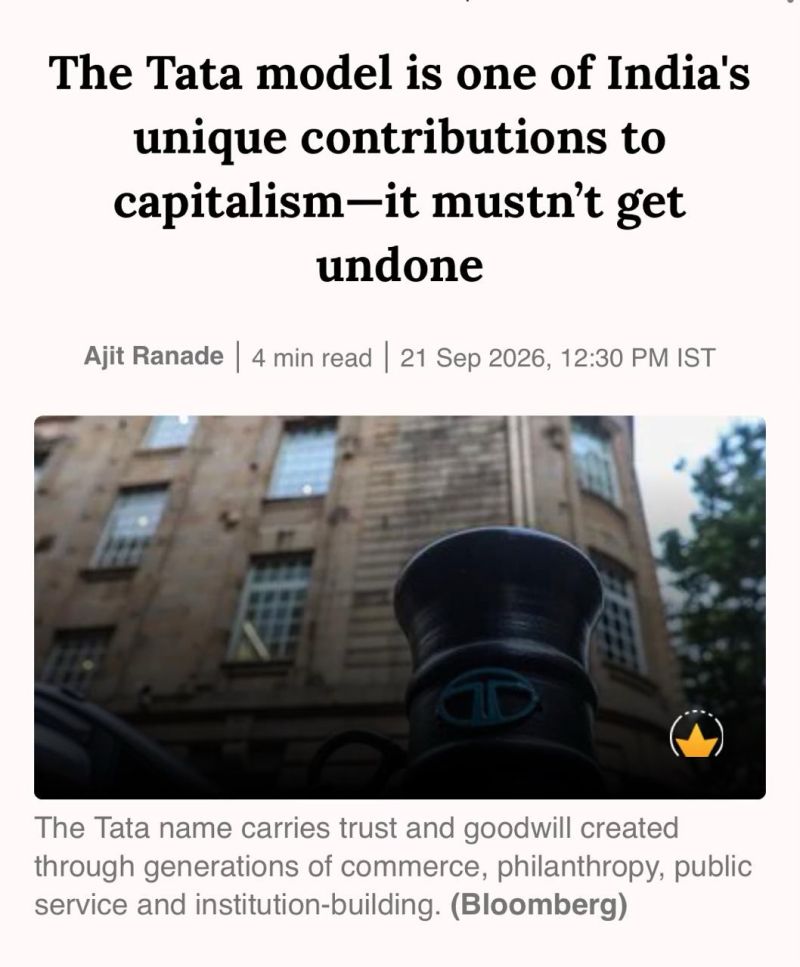
Ajit Ranade article in the Mint churned the pot and got Lutyen Delhi thinking. His argument is around the fact that the Tatas are way more than just another business. But what makes Ajit’s perspective valuable is that he was the economist in charge of the second largest CIC in India – the GD Birla group. His view is that just because RBI is unable to govern and regulate CICs, they can’t be dumped on sebi. But then the question that haunts:
WHO REALLY CONTROLS THE LISTED TATAS? OR HDFC ? OR L&T ?
At Bombay House, the architecture is almost a metaphor for the Tata Sons governance question: the listed operating companies sit below. Tata Sons sits above. And the Chairman’s office and boardroom sit on the fourth floor. It was a monumental disaster to separate the trust Chairman role from the Tata Sons role. Ratan Tata did that so he did not have to retire. And Cyrus Mistry agreed because he was hardly the type to oppose. And then when Cyrus Mistry was rather unceremoniously (and in my opinion illegally) sacked,
the slave King made an entry.
Whether sad or gay – it was not funny
Tata Sons was really a proxy for the Tata trusts. Like a shell entity to hold shares and raise debt. By separating the Chairman this umbilical chord got confused.
The Tata Sons Articles give the Tata Trusts significant special rights. Articles 104B, 121 and 86 deal with board nominations, affirmative votes and even the constitution of shareholders’ meetings. Most strikingly, Article 121A(h) addresses how Tata Sons exercises its voting rights in specified Tata companies on capital raising, debt, acquisitions and divestments. The Trusts don’t do this, Tata Sons does.
If comparable special rights existed directly inside a listed company, SEBI Regulation 31B would raise questions around shareholder approval and periodic renewal.
SEBI should examine such issues – not merely for Tata, but for the entire architecture of Indian promoter-less companies. Else Tatas is only a trailer for L&T and HDFC. The RBI has seen a slave King in ILFS. Nearby village. Same playbook. Rs 100,000 crore write off.
And there is an even more unusual possibility: some listed Tata companies themselves hold shares in Tata Sons. Could a downstream listed company therefore participate in preserving an upstream arrangement that influences how its promoter votes in that very company? In theory Tata Sons can invest say Rs 5 lac crores in say Tata Steel who can invest it back in Tata Sons. Creating Rs 10 lac crores of equity without investing a paisa. And maybe taking Rs 5 lac crores subsidy from the govt in the bargain.
The governed helping preserve the rules of their own governance.
Because modern corporate governance cannot be only about where power is legally housed. It must also ask where that power actually travels.
hashtag#TataSons hashtag#SEBI hashtag#CorporateGovernance hashtag#TataTrusts hashtag#ShareholderRights hashtag#CapitalMarkets hashtag#SamarthaBharat hashtag#IITAlumniCouncil hashtag#India
#578
2026