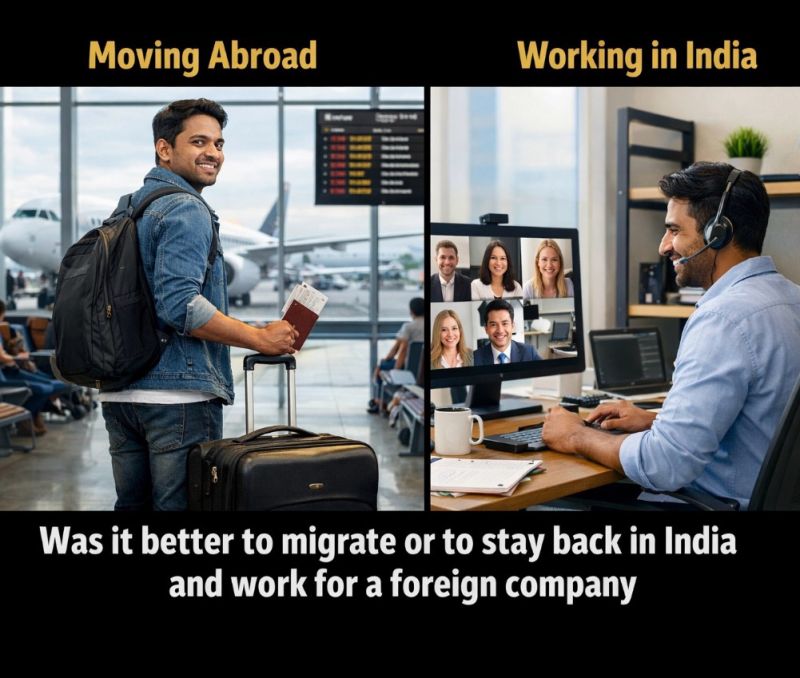
A IIT or IIM grad usually chose a job
Either overseas or for a MNC in India
What was better for India ? & for him?
The good thing about looking back is that you have data and facts. Looking forward you have hope and hypothesis. In the rear view mirror, vision is 6/6. So what is the answer for a premium grad who completed his graduation in India between 1960 and 2010 (take 1990 as median)
Here is the structured comparison.
⸻
India in 1990
• Licence Raj mindset. Lala companies dominant. Few domestic board run companies
• MNC India roles were mostly cost centers, not decision centers
• Stock options, product ownership, global leadership roles nonexistent in India
So the opportunity frontier was skewed.
⸻
Migrating overseas (US/EU) — the dominant payoff
For an IITian in 1990, migration offered:
• Access to the technology frontier (semiconductors, software, internet)
• Meritocratic acceleration — faster promotion, real ownership. Equity participation (stock options in the 90s tech boom)
• Exposure to Silicon Valley startups, Management pipelines, Research ecosystems (Bell Labs, Sun, Intel, Microsoft)
Outcome distribution:
• Median outcome: very strong financially and professionally
• Tail outcome: extraordinary (founders, VPs, early employees of giants)
👉 This is why diaspora dominance exists today.
⸻
Staying in India with an MNC — constrained upside
If one stayed back roles were largely:
• Support
• Services
• Local execution
Decision-making stayed abroad. Compensation ceiling was low. Innovation and risk-taking were discouraged. Well connected individuals scored over premium grads.
👉 India simply didn’t have the institutional scaffolding then.
⸻
The exception: entrepreneurs & institution builders
A small minority who stayed and:
• Built companies (Infosys, Wipro early leadership)
• Entered policy, research, or academia
• Later rode post-2000 liberalisation
These individuals had lower short-term returns but higher national impact and in some cases, large delayed wealth But this required unusual risk tolerance, political navigation skills and decades-long patience
In 1990, migration was the rational, dominant strategy. Here is a surprising find on the migrants. Those who did a PhD and took on a technical role did way way better than those who took on a general management role. Many of the PhDs pivoted to entrepreneurship and some pivoted again to become venture capitalists. The generalists remained employees. Most changed jobs often.
In India, those joining government service – including the civil services – made little money, suffered a poor quality of life and struggled for recognition . Contrary to public perception, few jobs (outside of banking and judiciary) have bribe income and most premium grads were not very good at corruption.
Banking and judiciary were the preserve of academic rejects and strongholds of the corrupt and incompetent. Any premium grads who strayed there was promptly ejected out.