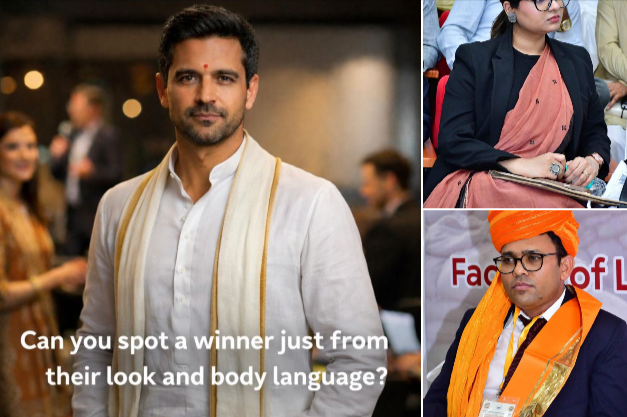
Is “Presence” Becoming Machine-Legible Capital? Even without consciousness, can Ai develop intuition. Or is it just data.
A iit alumni startup called Mintuition Pvt Ltd was able to predict winners at the India Ai impact competition with 100% accuracy. As well as the troublemakers who did the protests at the entry gate. They also detect shop thieves in San Francisco. And can tell you why a baby is crying (diaper change or pain or hunger)
And als the winners in the JVNU seminar last week – 2 out of 122. This is not a fluke. This is scary. Without knowing who they were or what they were speaking. All from live video footage.
Like a recent headhunter post put it:
We experience the same in executive search: In conversations with people, it’s often what is not said that matters most — body language, tone of voice, inner clarity.
I walk into a room. I know who the boss is. If I don’t, then it is just a bunch of hirelings with fancy designations and no authority.
Winners have a certain aura. The founder who walks into a room and owns it without raising their voice. Humans are remarkably fast at reading these signals. Within seconds, we infer confidence, competence, dominance, credibility.
Now AI can read them too.
Computer vision systems can analyze facial micro-expressions, eye movement stability, posture alignment, vocal modulation, hesitation frequency, even blink rates. Not because machines understand greatness, but because they learn correlations.
Consider hiring. Imagine two candidates with identical resumes. One appears composed, maintains steady eye contact on video, speaks in controlled cadence. The other is equally capable but fidgets slightly and speaks faster. If an AI-assisted hiring tool scores “executive presence” based on behavioral markers, who gets ranked higher?
Or fundraising. A founder pitching on camera with precise gestures, low vocal volatility, and confident posture may trigger higher “credibility” signals in automated analysis systems used by investment platforms.
When that happens, presence stops being soft power. It becomes machine-legible capital. A trait that can be detected, scored, ranked, and optimized.
The legal implications are not trivial. Under India’s Digital Personal Data Protection Act, 2023, automated profiling must have lawful purpose and safeguards. If algorithms begin evaluating human potential through behavioral inference, we move into complex territory involving autonomy, fairness, and bias.
Yet if machines reward visible signals of success, society may gradually privilege those who train for camera-readable confidence over those who possess quiet depth.
The deeper question is not whether AI can detect winners. It is whether we will allow pattern recognition to redefine what winning looks like. If presence becomes data, and data becomes capital, then aura is no longer mystical.
It is measurable. And once it is measurable, it will be optimized.