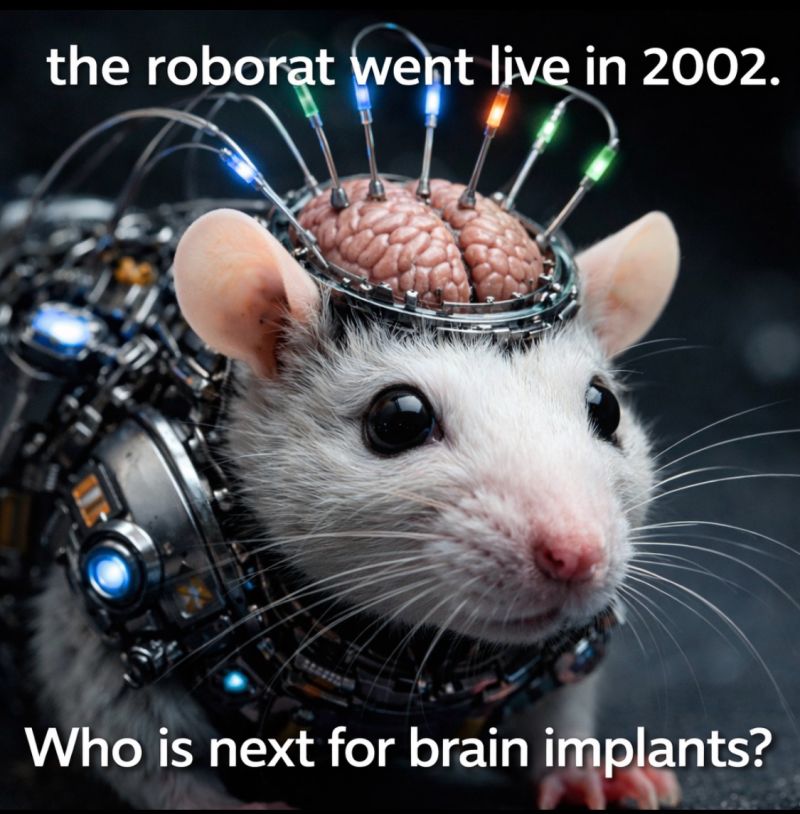
The “roborat” went live in 2002. It was built by a young doctor from Bombay in the U.S. it made a robot out of a real living rat.It stirred a hornets nest. This was an X Files technology.
Researchers implanted electrodes into a rat’s brain and were able to guide its movement remotely by stimulating specific neural pathways. It was one of the earliest demonstrations that behavior could be influenced through direct brain stimulation.
At the time it felt like science fiction. Dr Talwar’s brother Kapil Talwar is my IIT batchmate and a distinguished fellow of the IIT Alumni Council. I got to see a video of this rat going up a pipe and coming back. Fitting it on a human being was easy. The electronics could be easily adapted for a variety of tasks. Shortly thereafter, a company called Neuralink in Israel started working on something similar. Elon Musk is now driving this company. The CEO I think has borne him children and the company itself is ready with brain implant chips. It is really a single chip version of the backpack built by Dr Talwar.
These are dual use technologies. They can take over a living being and operate him like a robot. Living beings still have their uses till humanoid robot batteries get to comparable performance. Two thousand years after Christ, we now know a human being can be cloned. It does not require an egg. And so a virgin can be the mother of a clone. Star Wars spoke of clone armies, replicated by the thousands from one great soldier. Nearer home in Jaipur I saw cloned ponies used to play Polo. The best players travel with a set of cloned ponies. They are identical – genetically and epigenetically. You can order them in Jaipur. You can even choose a pony, edit the genes to adjust its height – and then order a few of them. The process and equipment to do so for humans is similar. An IVF clinic can be upgraded to manage this. Any bad actor can flout regulations and create a battery of cloned kids. Or designer babies. And roborat circuit can do the rest.
Today, brain-computer interfaces are moving rapidly from laboratories to real-world applications. One startup I mentor is already testing implants to restore movement and communication for patients with paralysis. They are looking at the entire spectrum of special kids. With a good and holy intent.
The technology promises extraordinary medical breakthroughs — but it also raises deeper questions about the future of human autonomy and cognition. As of now, there is no known regulation on this.
If a rat’s brain could be remotely influenced in 2002, the real question today is not whether brain implants will become widespread. It is who will be next — and under what rules.
Courts and law makers continue to live in ignorance. They say this is all too futuristic to be of relevance. My friend Srinivas Rachakonda is able to grow a 30’ high teak tree in 3 years.
It can’t be too difficult to grow a 6’ tall human being in 2 years.