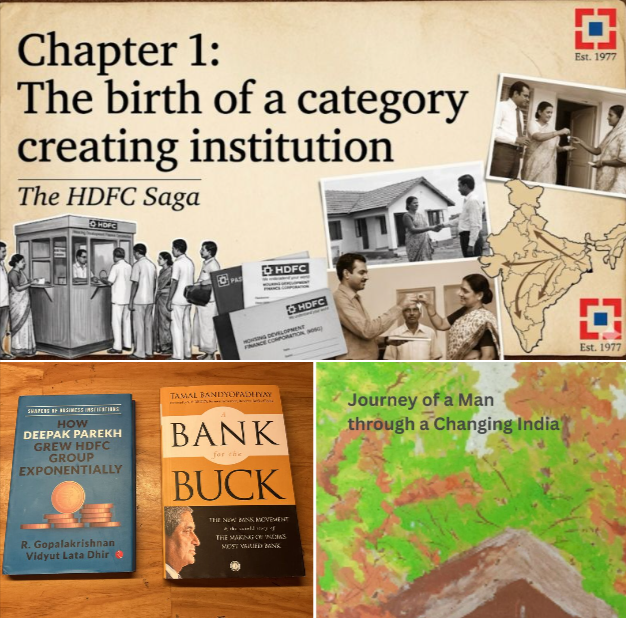
Chapter 1B: Success has many fathers. And history is not what happened but what historians reported and documented.
HDFC started its journey addressing the housing finance market for the salaried middle class. With a very simple proposition. Move to a suburban self owned house in preference to a downtown rented one.
It is not something HDFC wanted to sell. It is something the market wanted to buy. The difference is subtle but huge.
The success of HDFC came from two fundamental changes instituted by Pradip Shah — lending against income (when the norm was lending 7O% against the value of the flat, resulting in arrears of 40+% for coop housing finance companies) and lending against interim security, such as LIC policies/other assets that could be pledged. This enabled HDFC to lend against a flat that was nothing but a plan on paper with no mortgage rights.
Proposed by Pradeep Shah and supported by TN Nagendra — this went against Chairman HT Parekh and VC Keshub Mahindra’s idea of housing finance!
Perhaps because Mr Parekh wanted security of a mortgage for the loan or Mr Mahindra had seen HUDCO build and sell on instalments – which was their version of housing finance – led to the first signs of discord in the management. The CEO sensing massive growth potential in the idea – as it allowed the co-operative format over the “builder mafia” model of housing development – not only accepted it, but started scaling up operations around it. He ramped up recruitment. And a fresh set of youngsters were onboarded. This included IIT Bombay alumnus Deepak Satwalekar, Satish Mehta and Renu Sud karnad.
HT Parekh did not have children. His brothers children – Deepak and his sister Hansa – were more than his own. Unable to deal with the uncertainty of passing the difficult CA exam in India – Deepak had taken the easy route of getting a CA from England. After taking years to complete his articleship, he took up a lowly job in Chase Manhattan Bank at 2x of then prevalent Indian salaries. With a career going nowhere – HT Parekh brought him back to India – and to rapidly growing HDFC. Much against the CEO. And directly as head of operations.
In the meantime, the HDFC leadership worked out an innovative EMI formula, giving annual rest to the borrower for payments made by them so that they could augment HDFC yield beyond the 10.5% (and11.5%) that HT Parekh (the banker) had mandated be charged. The engineers got to work standardising documentation to a point that disbursing a loan was down to pulling out a docket and filling name of borrower and details of property.
In 1978, HDFC went public as an early stage startup. The issue almost devolved. L&T and Tatas saved it.
HT Parekh incentivated Pradeep Shah with a loan to go to Harvard from 1979-81. When Pradip Shah returned, he found a new organisation structure and a stymied role.
HT Parekh refused to retire.
TN Nagendra was retired at 58.
Making Deepak Managing Director.