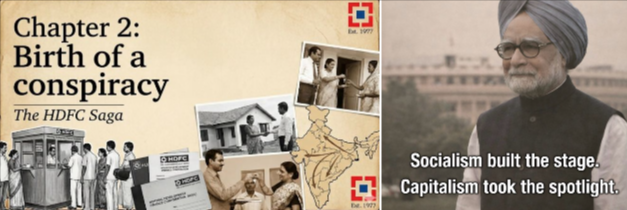
Chapter 2C: By the time, HDFC reached 1993, the contours of a conspiracy were taking shape. India was turning a new leaf. New industrialists were emerging like cockroaches from all corners. Most had nothing to bring to the table other than unemployability and ambition. All kinds of small timers wanted to become industrialists.
The world had debt free companies. India had equity free companies. But on paper, debt:equity was 2:1 or ideally 1:1. Rajasthan and Gujarat origin people started a new kind of manufacturing – the business of manufacturing equity. The foreign banks didnt lend money. They provided adjustment. Using this, you could get loans from corrupt bankers. And from the debt, repay the adjustment amount.
It was a new type of lending. One that carried no risk and gave all reward. They called it fee income. A better word was fraud.
By now the HDFC founders had gone away. TN Nagendra and Pradeep Shah parted ways in 1988. Pradeep went on to found Crisil – India’s first credit rating company and then set up India’s first private equity fund. TN Nagendra moved to Bangalore and took on some Board roles. HT Parekh finally retired in 1993 after anointing Deepak Parekh as his planned heir and successor. Shortly thereafter HT Parekh passed on.
1994 was the year a lot was happening. The service sector was being opened up. A large number of players were entering. Foreign players were playing havoc with market shares of domestic players. Income disparities were increasing. The world was globalising. China was beginning to rise.
All the old guard had been eliminated to smoothen the leadership journey for Deepak at HDFC. The foreign hand was now guiding him. He spent most of his time playing bridge with the south Mumbai cliche. But the foreign hand needed him to clean up his act so that the banking license could be got. He needed one ally. Some he could bully. But you don’t make an ally by bullying some one. You need to love them to get their trust. The centre of decision making was still Delhi. He found that ally in Renu Sud, an old timer who agreed to move to Delhi. Her job in Delhi was to leverage the clout of a lender to get Deepak onto every perceivable government committee and working group.
But the problem was that there were too many banks. And all had technology. On the other hand, Citibank was grappling with huge technology problems. Prime Computers had closed down. The entire network had been attacked. And suddenly they didn’t seem as bright as people thought they were. The other foreign banks too started flexing their muscles. Standard Chartered had an active owner in the Koo family of Singapore. ING, ABN AMRO, Bank of Tokyo, Deutsche, SocGen and countless others were nibbling away at their clients. The Indian Regualtors were closing in on them.
The going was not easy.
Something had to be done.
And done quickly.
#333
2026