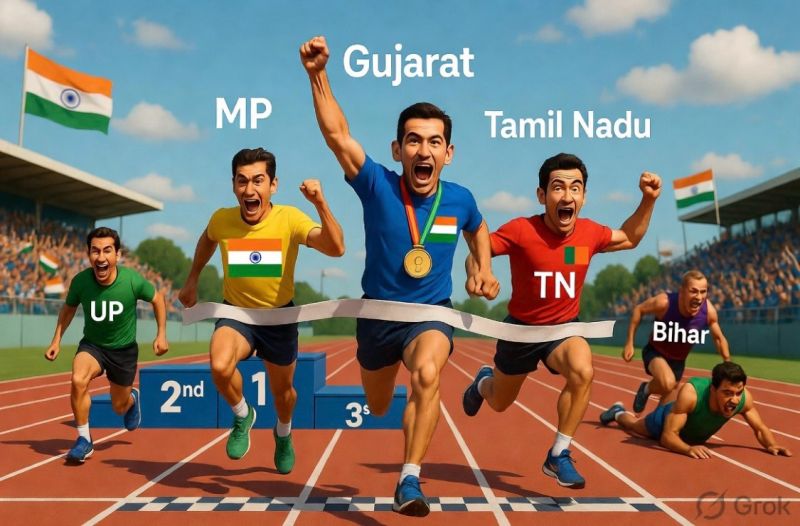
Few know that all states don’t have the same governance. In fact Gujarat, MP and Tamil Nadu are constitutionally structured to always beat UP and Bihar.
Section 169 of the Indian Constiution allows states to have a second house. Other than six states, all the states of India have two houses – Vidhan Sabha and Vidhan Parishad. Just like the Union Parliament has Lok Sabha and Rajya Sabha. And just like the Rajya Sabha members don’t have to contest elections. The Vidhan Parishads are a great place to park politicians who have lost the elections.
Why do some Indian states move faster on decisions than others?
A big part of the answer lies in legislative design. States that function without a Vidhan Parishad operate with a single legislative chamber, where the Vidhan Sabha becomes the primary decision-making body. This removes an entire layer of review, allowing laws to move from proposal to passage with far fewer procedural hurdles.
In bicameral states, every bill must pass through both houses. That means additional debates, revisions, and sometimes political friction when the two chambers are not aligned. Even when the upper house cannot block legislation outright, it can slow things down enough to affect momentum. In contrast, unicameral systems avoid this back-and-forth, enabling quicker responses—especially in areas like budgets, reforms, and administrativev decisions.
But speed is only one side of the equation. The presence of a second chamber also brings deeper scrutiny, broader representation, and a safeguard against rushed policymaking. What looks like delay can sometimes be deliberate reflection.
The real question, then, is not whether one system is better than the other, but what a state values more in a given context: speed of execution or depth of deliberation. The most effective governance often lies in balancing both.
But when it comes to approving projects, forming ppp companies, attracting mega projects etc – speed of decision making is critical. Vidhan Parishad members don’t retire at each election. They develop jagirs and can be very good at causing delays. Delays also help monetise their position and so on.
So next time you hear of Gujarat, MP and Tamil Nadu racing ahead of UP and Bihar – you know its structural – it is not that a particular chief minister is a genius.
The only exception is Andhra Pradesh which is a bicameral house and seems to be moving ahead rapidly. But that is more PR than reality. As of now, Andhra Pradesh is only making announcement – the mega projects are yet to take shape.