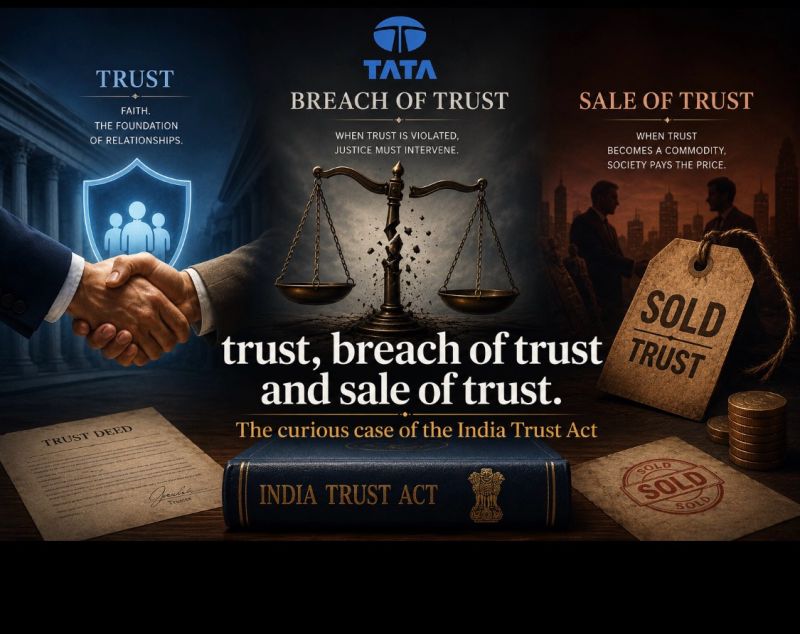
The Indian Trust Act needs a major and emergency overhaul. Right now it is no man’s land with the states doing all kinds of funny things and the centre having no clue about what to do. I have spent 40 years trying to understand this Act and everyday I come across new surprises.
First and foremost – every single entity from any mutual fund to Tata Trust to all the VC and PE funds – all duly approved, duly licensed and duly operating – are actually illegal. At least in spirit for sure. But actually in letter of law as well.
Sole check mate argument is that the Companies act does not allow Trusts to own shares and act as shareholders. Even the latest version of the Companies Act does not allow it. So how do Tata Trusts own 66% or even one share of Tata Sons.
It is a cardinal principle of common sense that what cannot be done directly should not be done indirectly. So this whole concept of owning shares held by a trust in the names of the trustees is complete nonsense. But it has precedent. The entire mutual fund and VC and PE and REIT industry runs on it. Judges etc don’t understand all this. Nor does NCLT (which is a joke in any case with every insolvency case becoming a scam). Chartered Accountants and Independent Directors may understand but who asks such fundamental questions. No one had IB schooling. Rote learning based education doesn’t go to good places. And you can pass LLB purely on rote learning.
Let’s analyse Tata trusts.
For generations, Tata Group built one of India’s most valuable corporate currencies — trust.
Not valuation.
Not market cap.
Not political proximity.
Trust.
That is why every dispute involving the Tata name attracts disproportionate public attention. Because when an institution becomes synonymous with ethical capitalism, every allegation of governance failure, internal conflict, or breach of fiduciary expectations becomes bigger than a corporate disagreement. It becomes a national conversation.
The real issue is not whether businesses will have disputes. Every large institution does.
The real issue is: What happens when trust itself becomes negotiable? Or worse it’s holdings are illegally held.
The Indian Trusts framework was built around fiduciary duty — the idea that certain responsibilities are sacred and cannot simply be monetized, traded, or selectively interpreted for convenience.
But modern corporate India increasingly operates in a grey zone between:
* trust,
* breach of trust,
* and sale of trust.
That is why the Tata disputes resonate far beyond Bombay House.
* Can institutional trust survive succession battles?
* Does governance still matter when control becomes concentrated?
* And when trust is commercialized, who protects the original stakeholders?
And who are the real stakeholders.
Hospitals and schools being purchased by the likes of Blackstone are all trusts. Who is selling them ? Who is getting paid ?
These are all illegal transactions.
Tata is just the beginning.