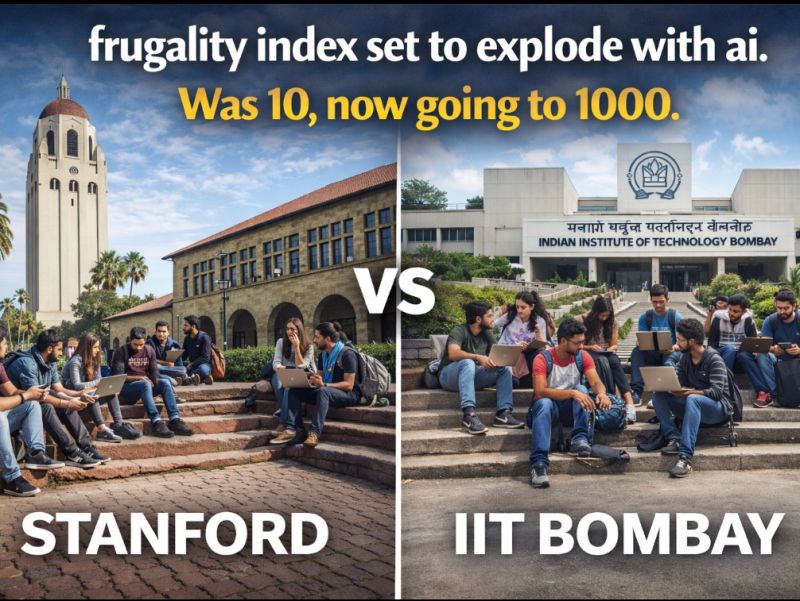
Frugality index better measure than PPP
PPP measures relative cost of burgers
FI measures cost of developing tech.
The multilateral banks developed the concept of purchase power parity. It is a nice framework. It basically says that the burger which costs USD 4 in USA will cost USD 1 in India. It is a measure of input costs. So if the salary of a professor is USD 200,000 in usa, equivalent person working in IITB will probably get paid USD 50,000. So somewhere this 4:1 ratio became some kind of a norm.
But when it comes to the cost of research we find an exponential ratio at work. So it is the inefficiency of the overall system which kicks in. And therefore the cost of American living makes the cost multiple for research work done in the U.S. to way more than 4:1. More like 10:1.
Ai is all set to disrupt this ratio. In India, just like servants at home make many more productive at their job, assistants and helpers in office help to make the senior person far more productive. Ai is exponentially increasing this difference. So whilst Americans at Stanford spend a lot of their time doing their dishes and laundry, the researchers are very busy at work. Whilst the Stanford professor is engaged driving his car and cleaning it – the Indian is using all the time to increase his delivery capacity whilst someone else drives him to work and cleans his car. With stable marriages and a strong family support ecosystem – minimal time is spent chasing dates or drafting pre nuptial agreements with divorce lawyers.
All of this ends up in a frugality index (FI) which way way higher than purchase parity. FI measures the relative costs of doing something in the contract research domain. An index of ten means that it costs 10 times more to do the same activity in USa.
Thanks to ai, the frugality index is exploding. Starting at around 10, around five years ago – it has now reached 100. And is on its way to get to 1000. This really means ai just made us 10 or 100 times more cost competitive. And this is just the beginning.
It is a matter of time before pension funds become insolvent and westerners have to shift to India to afford old age. Or to work if they are younger. As a country we will see people inflows of an unprecedented magnitude from the Global North. And we need to figure out an entry tax on them.
Stanford’s annual spend: $18.9 billion.
MIT: $4.78 billion.
IIT Bombay: $135 million
IIT Madras: $71 million.
$18.9 billion vs $135 million.
That’s not a gap. It’s a two zero chasm.
But let’s come to outcomes:
Stanford PhDs pa: 714
IITB PhDs pa: 560
Stanford BS pa: 840
IITB BTech pa: 1125
Now come to broader impact:
Stanford alumni: 2,10,000
IITB alumni: 1,82,000
Investable funds in alumni control
Stanford alumni: USD 400 billion
IITB alumni: USD 1 trillion