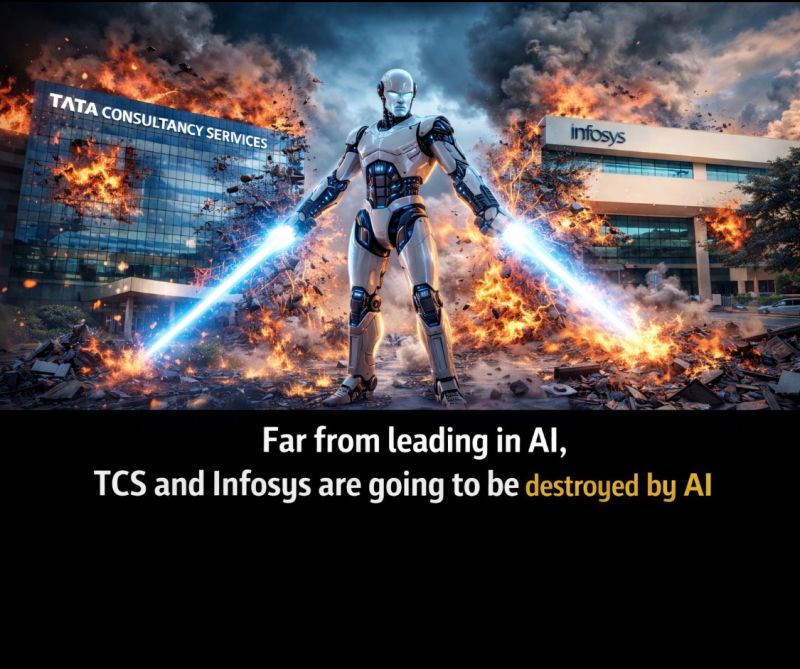
IT is different from AI
Incumbency makes migration difficult
India’s AI leaders will not come from IT
The one thing I have learnt is that adjacency does not improve probability of success. In fact it becomes the cause of failure. When you see a new industry, look at the new players to spot future winners. Tatas did not win in solar. Reliance did not win in groceries. Birlas did not win in anything.
Yet Adani seems to win in many things. Allegations of patronage apart – he approaches business from the vantage point of ignorance. And then allows for mistakes during experimentation. Making mistakes quickly and correcting them even faster. But even he has zero chance in ai.
We don’t know who will win from India in ai. But we do know that ai will eventually destroy IT and every other headcount dependent white collar job. As robotics will destroy blue collared jobs.
Indian IT companies are most under threat. The threat comes from a mismatch between how these firms make money and how ai changes the economics of their work.
For decades, large Indian IT companies have grown by selling human effort. Their revenues depend on headcount, billable hours, and long-term managed services contracts. software work required large teams to write, test, and maintain systems.
AI moves in the opposite direction. It automates repetitive cognitive tasks and dramatically reduces the amount of human effort. When productivity rises but effort falls, a business built on billing for effort starts to break.
This problem is intensified by the pyramid structure that defines most Indian IT firms. A small group of senior leaders sits on top of a very large base of junior engineers. Profitability depends on keeping this base large and highly utilised. AI inverts this logic. A few highly skilled professionals, supported by powerful models, can now do work that previously required dozens or hundreds of people.
Another weakness lies in what these organisations optimise for. Internal success has traditionally been measured through utilisation rates, cost control, and predictable delivery. AI-driven competition rewards fast learning, experimentation, and intellectual property creation instead. Companies optimised for efficiency and risk avoidance tend to adapt more slowly in environments where tools and techniques change rapidly.
Ownership is another critical issue. Most Indian IT firms do not own platforms, foundational models, or proprietary data. They implement and integrate technologies created elsewhere. As AI matures, the value of implementation work declines faster than the value of owning the underlying technology.
AI also shifts client spending away from long-term services contracts toward upfront investments in automation and internal capability. This undermines the annuity-style revenues that have sustained Indian IT for years.
Suffice to say the IT services industry will be among the early casualties of ai.