Kubernetes is the weak link
It is ubiquitous and limiting. For frugality
Kubernetes has to be substituted.
Let us first understand why this is so important and why Prana will be an absolute game changer. Not just for India. But for ai in general. And for specific applications like healthcare, transport optimisation and biomimicry
Kubernetes currently is to AI what Linux was to servers. It is really the only show in town. Even when companies say “we don’t use Kubernetes”:
-They often use something functionally identical
– Or Kubernetes is hidden under managed services
Like android and iOS who rule smartphones, Kubernetes is as American as is CUDA. Deep seek doesn’t scale without it.
Any serious AI platform—DeepSeek, OpenAI-style stacks, sovereign AI, national AI missions—eventually converges on Kubernetes-like middleware. That is the problem – and thus the opportunity. And the only monopoly India needs to break. Doing so needs brains and hands, not GPUs.
Key Difference between the conceptual architecture of the 2003 vintage Kubernetes and the 2023 origin Praana need to be understood upfront:
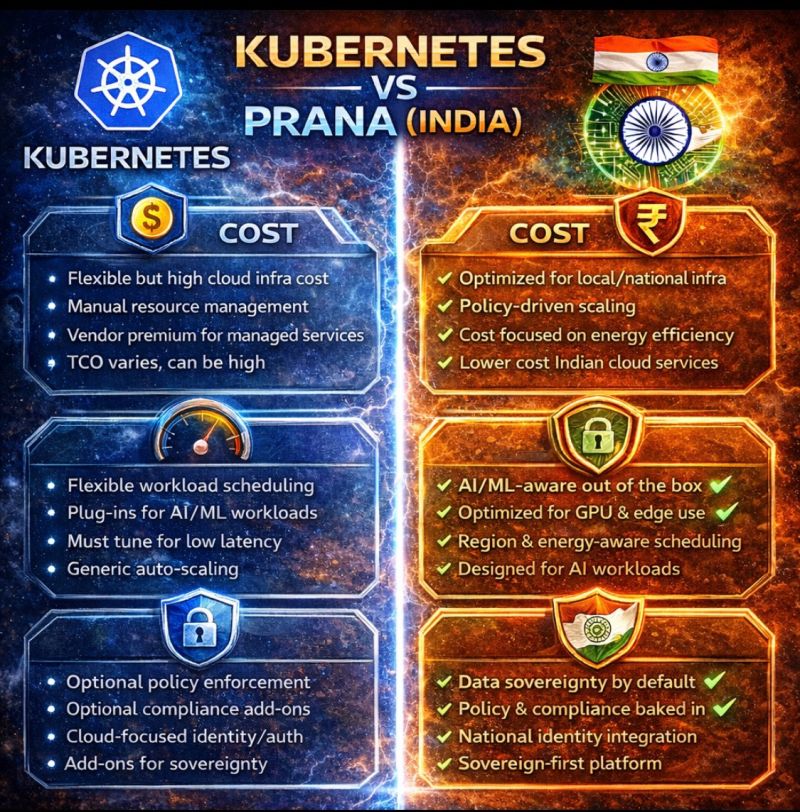
1. Kubernetes is designed for generic orchestration in heterogeneous environments. Prana is built for sovereign governance, security, and local policy adherence.
2. Kubernetes schedules generic workloads well. Prana would prioritize AI/ML compute & energy levels as fundamental criteria. Prana emphasizes policy-driven data flow within national boundaries.
3. Kubernetes is flexible but agnostic—Prana would bake data governance rules into storage placement. Praana architectural goal is edges of policy and governance, not just runtime security.
4. Kubernetes is global ecosystem-driven.
Prana would be regionally standardized with aligned platform partners.
As AI workloads grow:
• Kubernetes will continue to be the industry standard for container orchestration for all OpenAI clones.
• Prana – a Sovereign and strategic infrastructure stacks will focus on policy, security, and national governance challenges that generic cloud tooling doesn’t enforce out-of-the-box.
Kubernetes is proven and flexible; Prana’s architectural intent is to optimize AI/ML performance out of the box, especially when edge, energy cost, and sovereign requirements matter.
Governance is where the stacks differ most. Kubernetes relies on external policy frameworks and add-ons, while Prana aims for policy & compliance baked into the platform core — especially for national rules around data, identity, and infrastructure.
Final Takeaways
🟦 Kubernetes
✅ Flexible
✅ Massive ecosystem
✅ Cloud-agnostic
❌ Ops complexity
❌ Governance force fitted.
🟧 Prana
✅ Sovereign & compliant by default
✅ AI/ML performance tuned
✅ Cost & policy optimized
❌ Not open source
❌ Adoption curve for developers
When it comes to machine intuition and cost frugality, Prana targets a 1000x improvement in 100 weeks. And going live on 15.8.27. It is already available for developer partnerships.