The global GPU sweepstakes.
India has to standardise an architecture.
Else cartels will take over.
Today was the first kickoff meeting of the IITac Task Force for evolving the framework for a ai Regulator. TRAi is no longer relevant. The digital cable mistake should not be repeated.
BharatGen is one large potential customer for using GPUs. Out of the 12 ai foundational models supported by the govt, this one has received 92% of the total allocated funds. All of it taxpayers money. There is nothing foreign about ownership or control. Yet how would this venture move ahead without foreign expertise.
The indigenous GPU sweepstakes are the opposite. Out of the 8 venture funded startups, IBTV has garnered 86% of the total disbursed. But then is this really an Indian venture. With 24% FDI led by a semiconductor major, and 76% held by domestic AIFs – each with 0% govt participation – it would seem that majority ownership is non Indian. With double the Bharat Gen investment, there is zero tax payer money or govt control. Yet how can it really succeed without the blessings of the govt.
Both categories – one wholly govt funded and one without any govt funding – cannot move without relying on a base hardware architecture. And only the govt can make standards. Without standards and standardisation, you get cartels who will steal our data and loot our consumers (including the govt).
Standardising GpU architecture and interfaces is critical to ensure that the tens of billions of dollars going into neoclouds don’t go up in smoke causing further air pollution. Whilst no one from Adani to Ambani is a fool by any standard, history is replete with wise men making foolish mistakes.
Nvidia uses top end commodity chips mass manufactured at a very advanced third party fab. 9 nm pushing towards 5 nm and then you can go no more. Bulk of the power is used to move data at high speeds, not to process it. Their secret sauce is not just the chip but the ecosystem.
Ibtv uses bottom end chips which can be manufactured by literally any fab. 45 nm and they don’t want to go much farther. They use a fpga to make interconnects and connect fpga s with a photonic fabric to move data. They can do around 50% of what Nvidia can do but at 5% of their cost. So they are at 10x of Nvidia in price performance already.
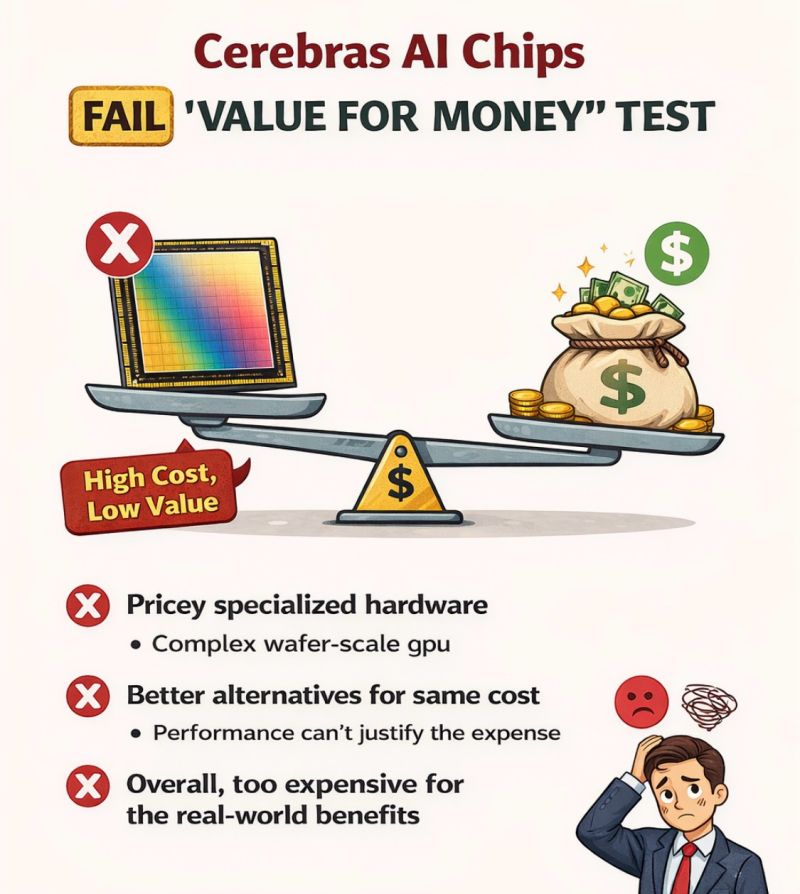
Big players apart, there is a third game in town. Cerebras
Cerebras says they will not make the chip tracks finer but make the chip larger. Humongous in fact.
Nvidia works at a one inch die. ibtv is smaller with 1 cm. Tsmc gets a yield of 82%. Ibtv attempts 95%. A 10% reduction in yield leads to a 50% increase in costs.
Cerebras wants to do a 12×12 inch chip. The equivalent of 144 nvidia chips in one. The advantage is they can move data freely within the chip. Sounds good in theory. It doesn’t work in practice. First prototypes apparently achieved a yield of 5%. This means 95% rejects. No go.
IBTV seems like the way to go.
But is it Indian ?!Activate to view larger image,