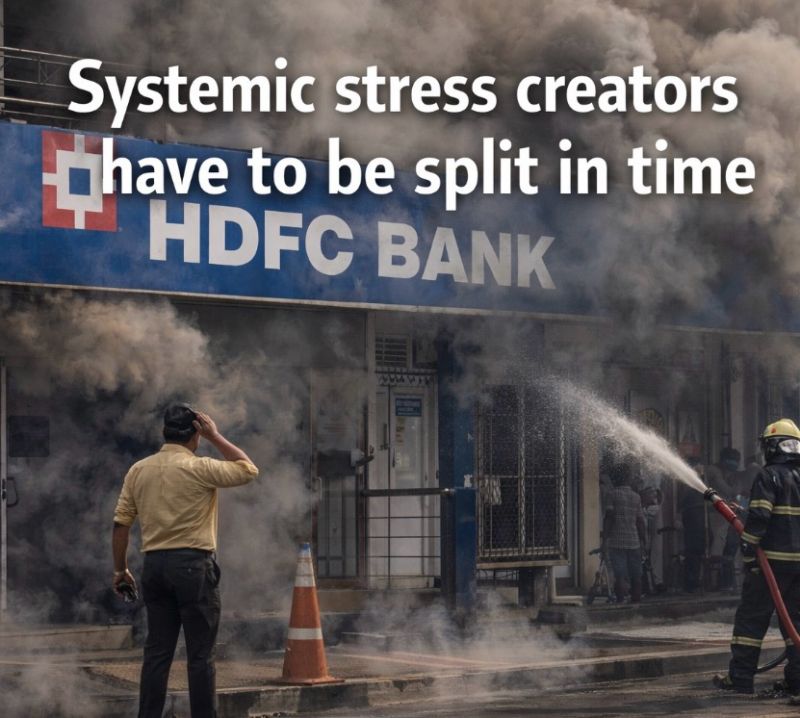
Hdfc’s immediate breakup is highly desirable.
With 98% of deposits distributed as loans
It is a systemic risk like no other
In the late nineties and early part of this century, the govt tried to widen banking through issuance of fresh licenses. Some failed soon, like Global Trust Bank and others like Yes Bank failed after a while. The smart ones acquired the failed ones like HDFC did.
But in general, the issue is not if they will blow but when they will blow.
HDFC headlines today announced with pride that 98% of all public deposits had been distributed as loans. A large chunk as luxury real estate and luxury fossil fuel car loans.
98% deposits disbursed as loans shows the bank is massively under capitalised and grossly over valued. Both make this entity a structural risk to both the banking and capital markets sector.
Private banks are structurally pro-cyclical. They grow fastest when the economy looks safest. Risk models are trained on good times, credit expands together, and asset prices hide leverage. When the cycle turns, those same “rational” decisions fail simultaneously.
As banks scale, efficiency quietly becomes systemic risk. Portfolios converge, interconnections deepen, and exposures look different—but behave the same under stress. At that point, failure is no longer idiosyncratic. It’s collective.
The liability structure makes this fragile by design. Long-term, illiquid assets are funded by short-term, confidence-sensitive liabilities. This works only while trust is continuous. When confidence breaks—even briefly—liquidity disappears faster than assets can adjust. Every banking crisis, everywhere, reduces to this mismatch.
Governance risk compounds with size. In India, promoter influence doesn’t vanish; it becomes indirect. Boards optimize for growth, not adversity. You don’t need fraud for failure—just unchecked optimism at scale.
Regulation in India is strong at containment, not prevention. Banks don’t collapse visibly. They are recapitalized, merged, diluted, or quietly absorbed. Failure shows up as a loss of independence, not a bankruptcy headline.
And in every cycle, the asymmetry remains:
private banks capture the upside, public balance sheets absorb the downside. That keeps risk-taking alive—and the loop repeating.
Leverage + cyclicality + scale eventually produce stress.
Stress invites intervention.
Intervention resets ownership and control.
Banks have to be regulated depending on their size. Internal discord, as seems to be the case currently can be very damaging. The Chairman seems to be unpopular because he is questioning the status quo. The status quo bears the signature of the “owner like” professional who ran the company from 1990 to 2024 like a “personal fiefdom”.
Given the uncertainties imposed by ai and Geo politics, it is imperative that hdfc either be nationalised or broken up to manage risk better.
It is a matter of time before the cracks appear.
And then they will soon widen.