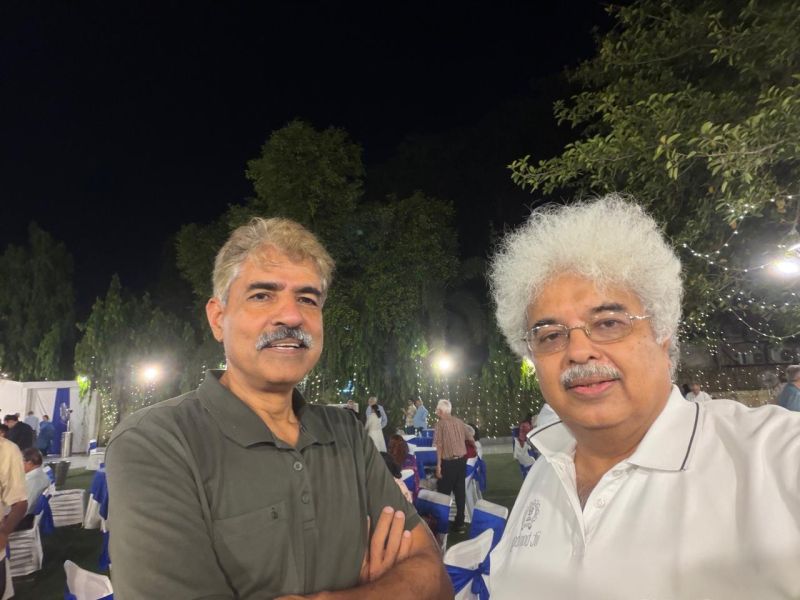
Is India on the right path in ai ? This was my question to the motley crowd that assembled at the Chaat Party 2026 in Delhi. The gathering had bureaucrats, wannabe politicians, industry leaders, investors, academicians, entrepreneurs, startups … like any iit gathering.
I posed this question to maybe 50 alumni over three hours, one conversation stood out. This was with Pankaj Jalote, Professor Emeritus at IIIT Delhi. An 1980 alumnus of IIT Kanpur and a PhD from Urbana Champagne – his career graph smells of leadership and domain expertise in ai from a mile away. He has been a faculty member of two IITs, founded IIIT Delhi and helps corporates like Infosys to set up research cells. It was a very enriching conversation.
To summarise – we need a 20 year plan to get to leadership in ai – not a 2 year plan. And it is probably not about government money or about money at all. It is about a research or innovation mindset, an enabling ecosystem and adequate production of talent – the raw material to build AI expertise. Industry can’t build researchers – academic institutions train them. And as of now, it takes five years to get a PhD out. China is a role model. Then enrolled PhD scholars in China and sponsored them to visit and work in America. The American professors saw them as cheap abundant talent and welcomed them. Then they went back to complete their PhD and started working in China. It was a return ticket.
India on the other hand gave out one way tickets – like Hotel California – to go but never to come back. So this is the first anomaly to be corrected. But doing a PhD is hardly fashionable in India. The joke once upon a time was that, “IIT has a product, by product and waste product” referring to B Techs, M Techs and PhDs. Then IIT Bombay flipped the script and exponentially increased the number of PhD students graduating each year. With an annual output of 500+ PhDs – IIT Bombay has the most favourable PG to UG ratio.
The NEP is also a disruption like no other. A student can enrol for an online graduate program which is extremely low cost. This will decimate the private universities and colleges which are essentially over-priced undergraduate factories. Universities like Mahatma Gandhi Vishwavidyala set up by Bharat Ratna Nanaji Desmukh now offer an online graduation for as little as Rs 10,000 pa. The IITs are offering a second degree in data science to complement the vanilla graduate degree. IIT Madras has close to 50,000 online students pursuing a BS degree online. The other IITs are offering both degrees and integrated masters programs with a flexible entry/ exit system.
Online courses are also being offered by the digital first universities which are designed to cater to a very large number of students with an extremely cost effective model.
Such models can expand the reach of quality branded education to the masses. And when they add doctoral programs – they will be able to produce PhDs by the tens of thousands and maybe more.