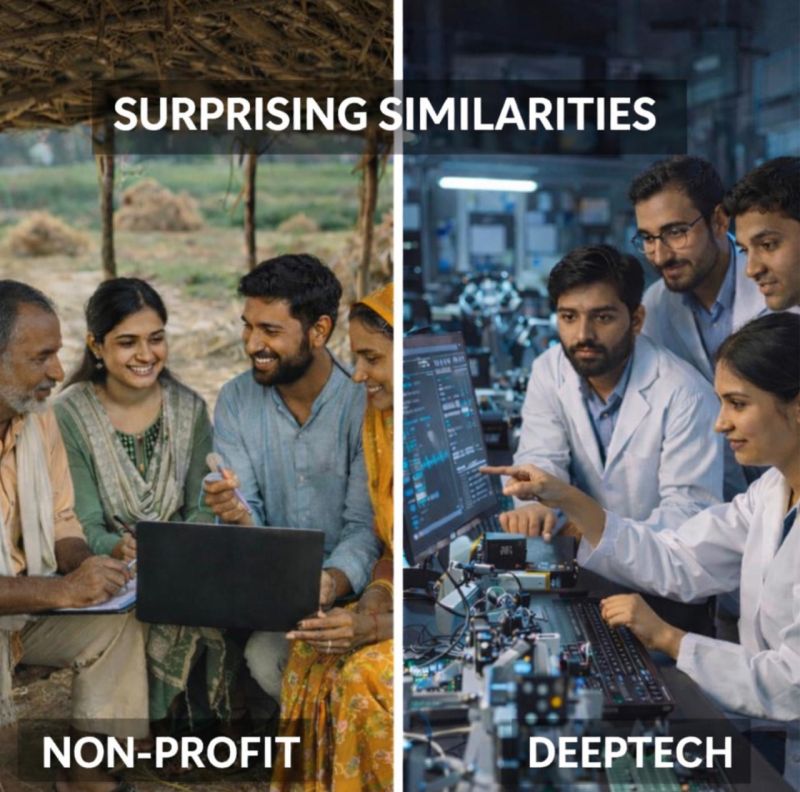
Why do many successful non-profits start behaving like deeptech startups? Because structurally, they operate under the same conditions.
Deeptech investing is not new. Nor are non-profits. It is just that the numbers have changed by orders of magnitude. And as the numbers get larger, the game changes.
When a paradigm change occurs, the probability of massive returns – whether in the form of impact or valuation or profits change. Donors and investors find comfort in numbers. It becomes fashionable and then the herd mentality kicks in.
There is only one basic and fundamental problem. There is no one wanting to be helped and there is no promoter seeking funding. All you have are donors and investors. Both with more money than expertise. And in a hurry.
Both are trying to build something important but not yet proven.
Startups promise future wealth.Non-profits promise future impact.
In both cases, the present is funded by belief in a future outcome.
This creates strikingly similar behaviour:
• constant fundraising• strong storytelling and vision• rapid experimentation• obsession with scale• mission-driven teams willing to work under uncertainty
In fact, the startup paradigm may be the most effective model for non-profits seeking global relevance. As well as vice versa. In fact it is one paradigm.
Why?
Because global impact requires the same capabilities that successful deeptech startups develop: perseverance in experimentation – trying new models for solving social problems Narrative power – attracting donors, partners and governments
Scalability – moving from local success to global reach. Never mind if the local success is only make belief. Or if early experimentation is not really showing any path to the finish lines.
It is not a scam. It is uncertainty.
Traditional charities often focus on service delivery. But globally relevant non-profits behave more like innovation platforms. Gates Foundation is a talking shop with no walking.
They prototype ideas, test them in the field, refine them, and scale what works.
In other words:
The future of high-impact philanthropy may look less like a charity…
…and more like a mission-driven deeptech startup.
And the future of deeptech startups is with a real risk of never reaching revenue stage years later.
In fact, think about it carefully.
The best way to fund a deeptech startup is from a Social fund. So there is no commercial money. No delivery pressures.
If you can find the entrepreneurs.
It will work.
The issue is the “IF”
Similarly if you can find the poor people wanting to be helped, it will work. Again the issue is the “IF”. Because the governments don’t like non-profits interfering in their monopoly over the poor.
It is easier to get votes if people remain poor. Same way, it is easier to be trader industrialists if you don’t have to compete with deeptech companies who may change the paradigm.