The current smartphone and mobile network are both dead. As is the need for real time voice.
Thought to speech is a very slow process. It is limited by how fast we can speak or type. At the other end, the recipient has to reverse the process. He has to hear what you have said and convert that back to thought. In between noise is introduced.
To give an approximate analogy, semantic communications looks at sending the thought directly. Video too has similar issues as voice communications.
For 30 years the telecom and video conferencing industries have been optimizing the same thing: moving pixels efficiently across networks.
Companies like Zoom, Cisco and Microsoft built powerful platforms around codecs, packet transport and bandwidth optimization. But a very different paradigm is emerging through semantic communications.
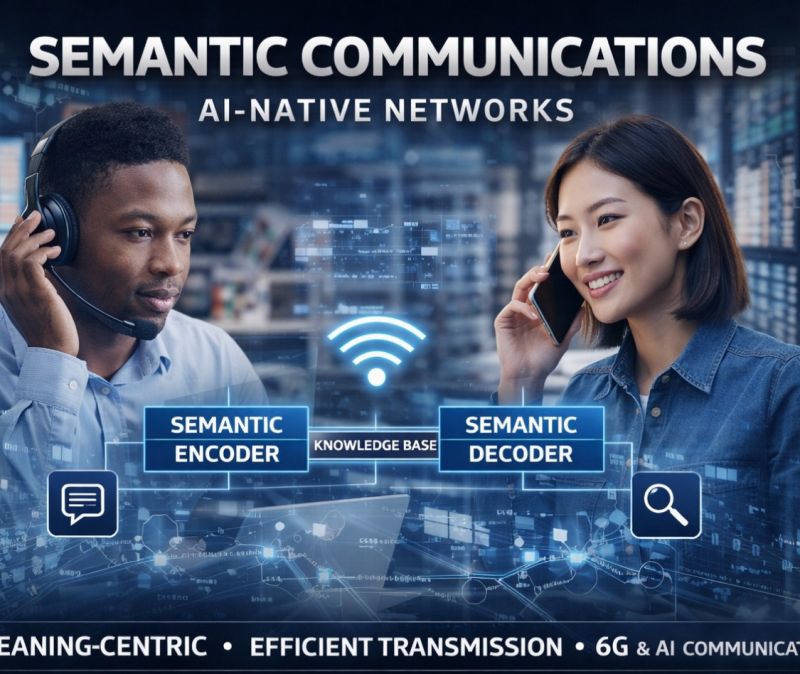
Instead of transmitting pixels, AI systems extract the meaning of the scene — facial motion, speech, gaze, objects, and intent — and transmit only those parameters. The receiver then uses generative AI to reconstruct the video locally. Or better still, the gist can be fed either into his brain or to his external memory.
This external memory is not dumb memory like the old data centres. It is intelligence coupled with memory. Think of your wifi access point being like a ai server.
In other words, the network no longer sends video. It sends instructions to generate video. And that fundamentally changes how networks will work. The implications are profound.
What we are optimising is not bandwidth but the viewers attention. Finally that is the only scarce yet valuable commodity – if you can call it that.
A traditional HD video call may require 1–4 Mbps even with advanced codecs like H.264 or AV1. U need 60 minutes to watch one hour. You need to absorb this in six minutes or six seconds. Maybe just catalogue it in your mind and park it in your memory. So your ai server memory is like an external memory pack for your brain.
Semantic communication systems being explored in 6G research could reduce that to tens of kilobits per second — or even lower.
This challenges the core assumption of the telecom industry: that future demand will require endlessly expanding bandwidth capacity. It won’t. Bandwidth may not be saleable as such. And that signals the end of the telco business model.
If communication networks shift from transmitting data to transmitting meaning, the entire stack changes:
Camera → AI semantic encoder → network → generative renderer.
The center of gravity moves away from codecs and bandwidth toward AI models and neural rendering.
Which means the next generation of communication platforms may not be built by telecom vendors or conferencing companies at all. They may be built by the companies that best understand how to model and reconstruct reality with AI. And to extract from your brain or feed into your brain.
The network of the future may move meaning. Not files.