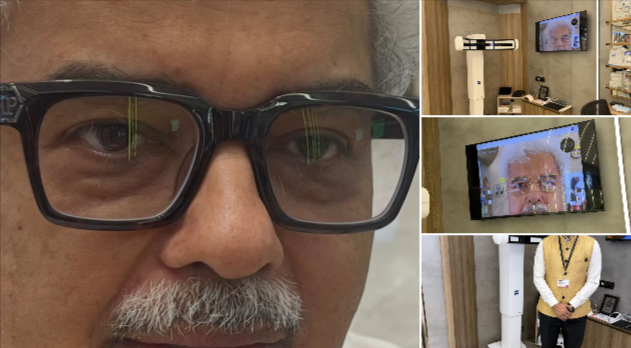
Spectacles have not changed for three hundred years. First lenses were made from glass by grinding. In the 1980s, pre moulded plastic lenses made an appearance. And then nothing new happened.
That is until now.
Last week an IIT alumni startup managed to use physical world ai to inflect good old spectacles. The stealth mode startup has managed to deflect light rays digitally using ai. The extremely low power chipset can adjust the focal length of a flat piece of LCD in real time by tracking the retina. It works like an eye checking machine which adjusts to bring the test object into focus.
The challenge till now has been to position the spectacle precisely at a known position vis a vis the retina. This require an accurate 3D scan of the face somewhat akin to how a 3D xray scans your teeth. Except that here the scanner has to work on optical light. Premium optometrists now have these 3D scanners and can fit a lens at the precise position where it is required to be fitted.
It has now been around 48 hours since I have been wearing what are probably the worlds first pair of electronic lenses which can adjust the focal length based on what I am seeing. It is thin edge ai with neuromorphic computing at its very best.
Interestingly these glasses have not been designed for humans. They have been made for humanoid robots who need to see the world the way humans do. One will need to wait and watch where this startup goes. Finally they are not just spectacles but robotic eyes. The spectacles will see with or without human eyes. And this is what changes the paradigm completely.
The spectacles have cameras which can feed into a smartphone exactly the same way as meta ai glasses do. But they don’t stop there.
They can feed the image signal directly into the brain bypassing the eyes completely. Some people may have read about a blind person scaling the Everest unaided. He did so by using what is called a lollipop sensor. The sensor connected to the spectacles is like a lollipop. It relays the image signal to the sensitive cells of the tongue and the brain reconstructs the image by learning to read these image signals. For a higher resolution image, the sensor is a large sticker patch which is fitted on the back. It is a matrix impulse generator.
Using the same concept it is possible to get the skin below the watch to act as ears. Ultra sensitive microphones based on fibre optic devices sensing light beam movement can hear what no man or beast can hear. The signal can be fed directly to the human brain from the contact between the back of the watch and the skin.
Most people cannot even comprehend what is already available. Those without eyes can see and those without ears can hear. But more interestingly those with eyes and ears can get a second input channel. One that can be zoomed to a source. And of course the brain can watch a movie with sound without using the eyes or the years.
Tomorrow happened yesterday.
And this is just the beginning.