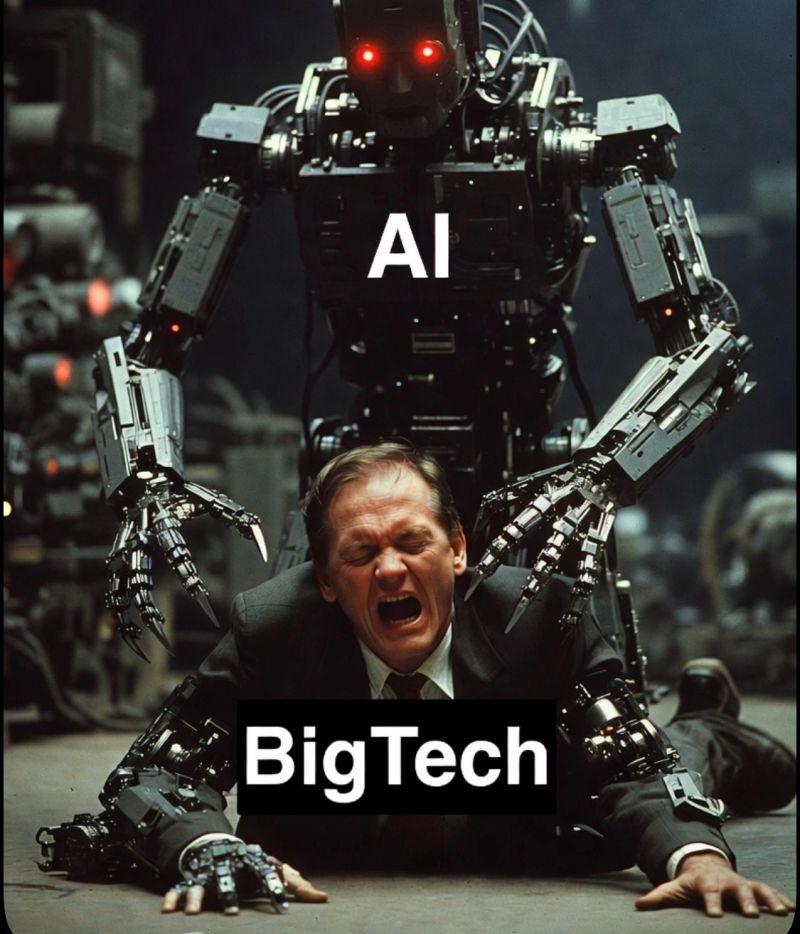
A lot of people assume the next AI giants will be today’s BigTech. That assumption is wrong. I will bet my 40 year reputation on funding technology on this one definitive statement.
Every major technology shift has punished incumbents who believed scale alone guaranteed dominance. The internet did not crown telecom monopolies. Cloud did not belong to hardware giants. Mobile did not reward desktop leaders. Platform resets redistribute power. They don’t preserve it.
AI is not an incremental upgrade. It is a structural rewrite.
Jio and Airtel will die. And so will BigTech. The future Google or Apple or Nvidia of AI will soon emerge. Has probably already been born. And it will not be from Silicon Valley.
BigTech and Big4 have the same dilemma. They are designed for leadership in a world which no longer exists. The rules they play by have no takers. Their investments are a liability. Their leadership is not sustainable.
BigTech is optimized for protecting existing revenue streams, defending distribution, and maintaining predictable growth curves. AI, in contrast, is chaotic, margin-compressing, and cannibalistic. It reduces the value of interfaces, middle layers, and even software itself. It threatens advertising models. It challenges app store economics. It collapses SaaS differentiation. It commoditizes knowledge work.
To win AI, you must be willing to destroy what currently makes you powerful.
That is not easy when you are worth a trillion dollars. Even harder if the figure is larger.
The next AI giants will likely be companies that have nothing to protect. And nothing to lose.
They will be AI-native from day one. Model-first. Cost-obsessed. Vertically integrated. Comfortable operating at thin margins while compounding intelligence. They will not think in terms of “features.” They will think in terms of replacing workflows entirely.
BigTech has capital. It has distribution. It has data. But it also has inertia.
And inertia kills during paradigm shifts.
AI compresses time. A small, highly focused team with the right architecture can now challenge institutions that took decades to build. Foundation models are spreading. Open ecosystems are accelerating. Compute is becoming more specialized. Distribution is fragmenting. Power is decentralizing faster than incumbents can reorganize.
The uncomfortable possibility is this: the next AI giant may not look like a tech company at all. It may look like a healthcare company, a manufacturing company, a defense contractor, or an education platform that embeds intelligence so deeply that software disappears into the background.
BigTech will participate. Of course it will.
But history is ruthless with incumbents who mistake size for inevitability.
The real question is not whether BigTech will lead the AI era.
The real question is whether it can survive at all.
And when the end will come.
IBM still lives.
But the glory is gone.
BigTech will be like IBM