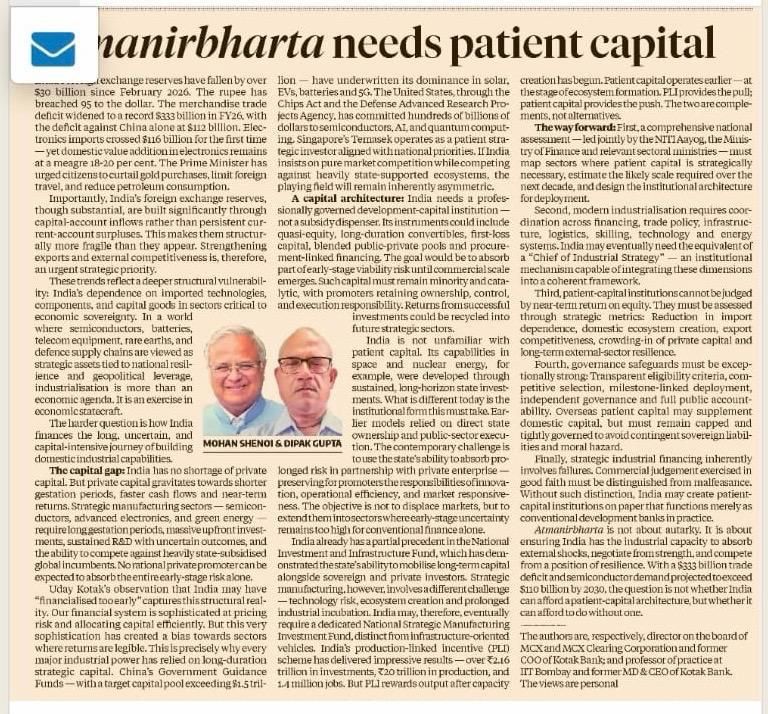
Dipak Gupta usually has a sharp, well researched narrative. As Chair of the largest private equity pool in India, he has a perspective which is as comprehensive as it is unique. For data on PE, he is the original source.
I read his article with interest.
Aatmanirbharta Needs Patient Capital, Not Just Private Capital
India often debates industrial policy as a choice between the state and the market. That may be the wrong question. The real constraint is capital architecture. And that is why we are a capital starved nation and those who lay their hands on public funds – be it LIC or HDFC or the original havala banks – were kings.
Private capital is exceptionally good at funding businesses with predictable cash flows and relatively short payback periods. But strategic industries—semiconductors, advanced materials, batteries, defence technologies, clean energy, and deep tech—don’t fit that model. These are industries needing continuous assured inflows and uncertain outflows. In fact they defy most rationale on risk management. Failure rates are high. Uncertainty is high. But yet some strange fate of events had made TSMC what it is.
No major industrial power built these sectors purely through conventional private finance. They had strategic finance – a polite word for money that seeks strategic advantage but not financial return.
China has its government guidance funds. The US has the CHIPS Act and DARPA-style funding. Singapore has Temasek. South Korea and Japan built similar long-term financing institutions during their industrialisation.
India has precedents too. Our space and nuclear programmes were built with patient, mission-oriented capital. The tax payers money. And the tax payer had no say in it. Viability had gaps. It was certain commercial finance wasn’t interested.
The next phase of Aatmanirbharta may require the same approach:
* Professionally managed development capital,
* Public-private risk sharing,
* Long-duration financing,
* Minority, commercially disciplined state participation,
* Institutions that absorb early-stage risk while leaving execution to entrepreneurs.
This is not about replacing markets or picking winners. It is about recognising that markets alone often underinvest in sectors with high uncertainty but enormous national and economic value.
Industrial policy without patient capital risks becoming a slogan. Patient capital without accountability risks becoming a subsidy. The challenge for India is to build institutions that deliver both. For now we call them AIFs. And the investees are called startups
Aatmanirbharta is ultimately not about technology alone. You need capital goods and capacity. If you can’t control capital goods- you become a disaster like the Indian steel industry. Prices 40% higher than China.
100% reliance on imported capital goods.
And this means 0% self sufficiency.
For a country that is not atmanirbhar in a 100 year old technology. What is our chance in solar or batteries ?