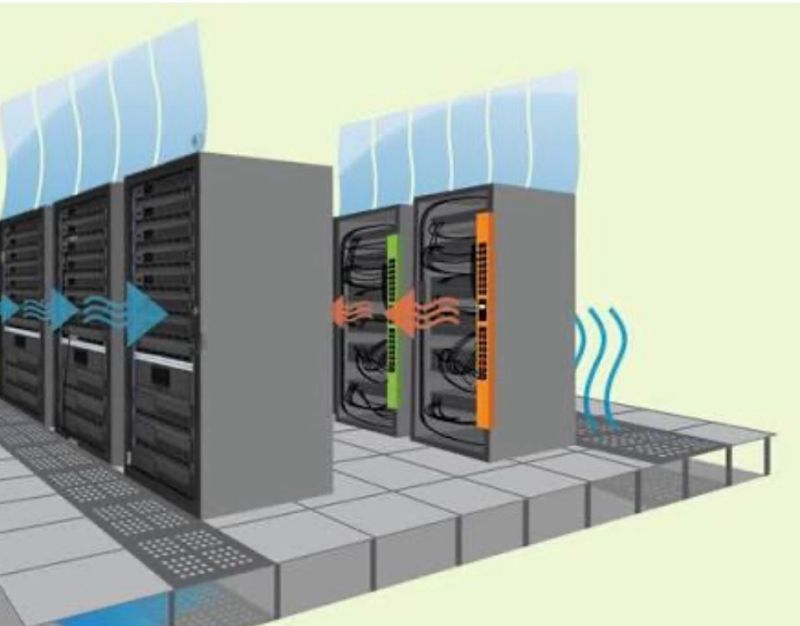
Data centre cooling has two fundamental approaches. One is to remove heat so as to avoid hot spots which could damage the semiconductor devices. The other is to recover heat energy.
The science of refrigeration has not really changed for over a hundred years. Cooling systems run on something called the rankine cycle. Essentially it involves interchanging between mechanical and thermal energy. In simple terms, it says compression causes heating and expansion causes cooling. The task then is to transport the cooling from where it is generated to where it is required. We use a fluid to do this. To give an example, think of a split air conditioner used in homes. The outdoor unit has the compressor where a refrigerant is compressed and expanded to generate cooling. This is then carried by a pipe to the indoor unit where a fan transfers the cooling to the air. This system typically has a coefficient of performance which is around 0.8. This means that 1 kw of electrical power will generate cooling which is 1 kw less heat losses.
Data centre cooling solutions currently used don’t change this. Instead of carrying the cooling fluid to the indoor unit of a ac, they take it directly to the chips so that they can be cooled at the point heat is generated. They use water as the cooling fluid. For a lot of cooling, you use a lot of water.
But Rankine Cycke is not the only way to cool. There is a better option. It is called Carnot cycle. Ashok Jhunjhunwala at the IIT Madras Research Park has done some path breaking work in the area. At the top is his realisation that you can actually generate way more than 1 kw of cooling using just 1 kw of electricity. You do this by using electricity to produce two streams – one cold stream and one hot stream. Now the Carnot cycle helps you to use 1 kw of heating to produce say 3 kw of cooling and 4 kw of heating. Such that when you combine the two, you get the equivalent of 1 kw of heating.
The Japanese heater makers were the first to latch on to this. So instead of conventional electric heaters, they made the equivalent of reverse air conditioners. When they did this, they were magically able to produce 4 or 5 KW of heating from 1 KW of electricity. It seemed to violate the law of conservation of energy. Like magic.
But it doesn’t. India is the first country in the world to use this concept for water free cooling of ai data centres. And the technology has been proven for cooling racks upto 100 kw. And seems scaleable without a problem for data centres with upto 10,000 Nvidia H200 type of GPU immediately with a short term path to 50,000 GPUs.
The first data centre with this cooling is scheduled to go live on Aug 15th using the Ionique system.
It is India’s first real contribution to the ai hardware ecosystem.