One of the most interesting innovations in building technology comes from the BAPS Akshardham organisation.
My journey with them started around 25 years ago when the Akshardham temple was being built in New Delhi. This temple was to be built in a river bed on a relatively non-load bearing plot. What followed over the next 36 months was the most high tech construction ever done for a temple.
Statues from old temples were scanned in 3d. The captured image was imported into autocad. The file was adjusted in size and shape etc and made into the equivalent of a Lego block. This image was then converted into a piece of solid marble by machining it with a 12 axis CNC machine. These blocks were assembled into a Lego like structure using tongue and groove joints into a massive structure weighing tens of thousands of tons.
Remember a Hindu temple does not have any steel reinforcement in the roof. So this temple is more or less built the same way as a temple was built 2000 years ago before the advent of RCC. Just that the individual pieces were carved by a machine and not by hand.
The physical temple was in effect just a replica of the computer made digital twin. Now if we use a ai based large image model – we could build the digital twin in around ten days. In 2000, this took 14 months.
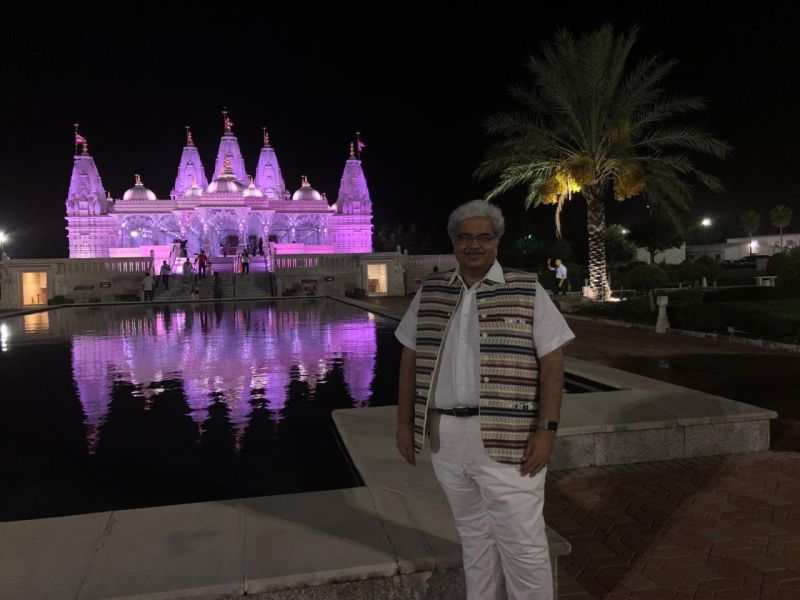
Now fast forward to Sugarland, Houston, Texas. I had the opportunity to visit the Askhardham temple courtesy my batchmate Bhushan N. Vaidya. And thanks to the arrangements made by Swami Teerthashankar. The temple here was a better version of Akshardham Delhi. The machines had got better. So resolution was way better. The cameras used were of way better quality. Now there was no reason to actually visit ancient temples to get 3d scans. You could do it from images on Google which get stitched using epipolar geometry and fundamentum matrices.
As photogrammetry goes this is completely non trivial as you have no knowledge about the lens and camera details. You have to calculate these. And then you have to convert 2D images into a 3D voxel map which is then used for either 3d printing or cnc machining.
Akshardham Delhi has now withstood earthquakes, floods, extreme heat and lightning strikes. There is no visible degradation. And the BAPS organisation has done a brilliant job of building temples remotely. The design and fabrication is done in India. All the pieces are packed into containers and dispatched to places like Houston, New Jersey, Australia and Abu Dhabi .. where armies of volunteers and local contractors assemble the entire design in weeks rather than years. Recently BAPS inaugurated the largest Hindu temple outside India in New Jersey.
It is now trivial to replicate an Ankor Vat of Cambodia or for that matter the Church of Holy Sepulchre of Jerusalem or the St Peters Basilica from Vatican. And India has 30 years of experience and at least ten temples standing in marble and lime (no cement and no steel) – this capability didn’t come from IIT Roorkee.