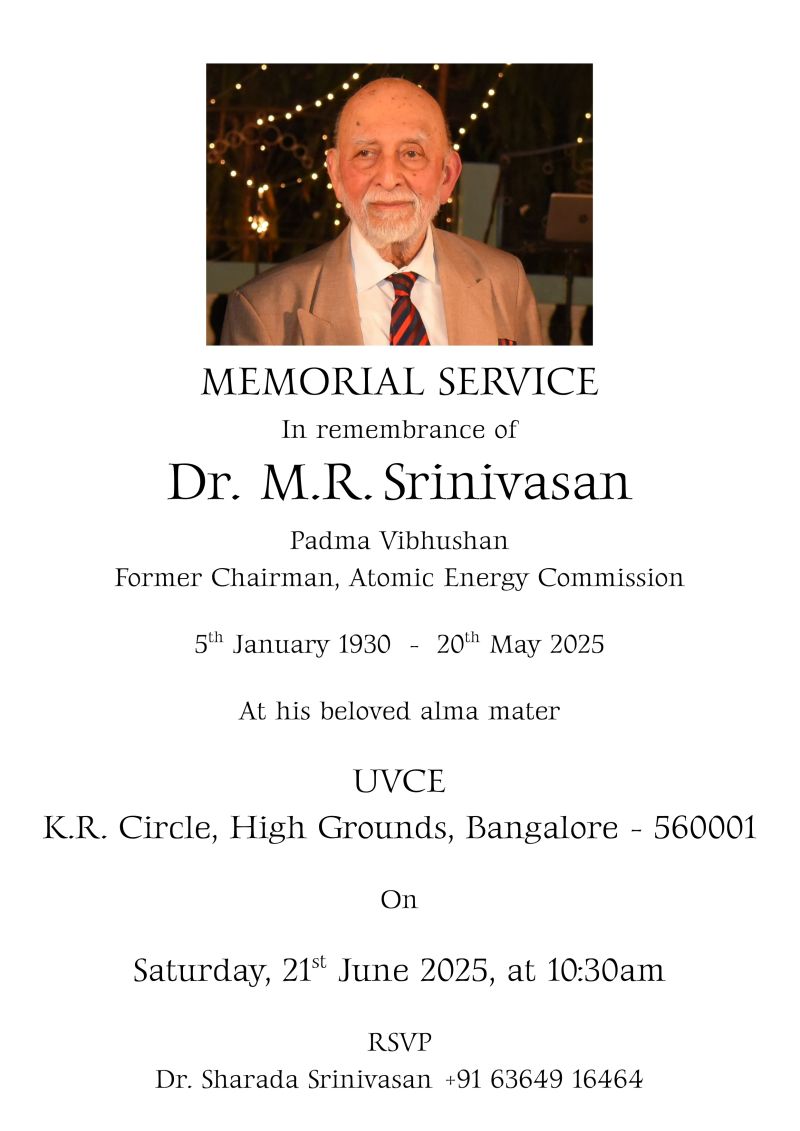
The memorial service of Dr MR Srinivasan yesterday really signalled the end of an era and took me back forty years in time.
As a third generation engineer, I had grown up to look upon chemical plants as safe and nuclear power plants as something to be feared. My father used to work in a petroleum refinery. My childhood friend and classmate Padma Sri Prof Sharada Srinivasan’s father on the other hand worked in the Nuclear Power Corporation – something we rarely associated with “safety”. Nuclear was a synonym for Bomb.
In 1983, Sharada and myself joined IIT Bombay to pursue a BTech. She had a JEE rank which was 200 ranks above mine. She joined Engineering Physics – a new branch started that year – and was designed to be a starting point for nuclear physicists. I joined the course my rank could afford and which seemed closest to petroleum – chemical engg. Any illusions of grandeur I had were quickly dispelled in the first day at the hostel when a senior from computer science corrected me with “it is not chemical but Kum Ackal or ‘less brains’”. Sharada was not just a childhood friend – she was also my favourite photography model and probably the best classical dancer on the IIT campus. Dance for her was a religion – engg a side passion. One topic of discussion on the way back home to south mumbai on the weekends from powai was “chemical is safe and nuclear isn’t”.
And then one day, the Bhopal tragedy struck. Exactly across the lawn from my hostel room was the CS senior who had made me Kum ackal. This was Professor Madhavan Mukund. Now India’s number one mathematician by far. Director of the Chennai Mathematical Institute. If there was a “genius” in my vicinity, it was him.
His father J Mukund was head of the ill fated Bhopal Plant of Union Carbide.
That was the day – 3rd December 1984 – when I figured out in my head – that one I need to find a career other than running a chemical plant. And second, nuclear was niether unsafe nor unviable. When you deal with tens of thousands of tons of inflammable or poisonous materials – it just can’t be safer than a nuclear reactor dealing with a few kgs of radio active material. By 1985 I had become a convert.
In April 1985 I summoned up some courage and cycled down to L & T in Powai. AM Naik was then head of Group 2. SS Sidhu was the GM. Mr MK Patil was the manager. And I was a trainee whose engg education had been sponsored by L&T. I had been told in my interview that I should think out of the box.
I walked up to Mr Naik and announced “why don’t we redesign a gas based fertiliser plant to run on nuclear power?. The deisgn will become simpler and the fertiliser will become cheaper.”
This was not out of the box thinking. I had thrown the box away. Mr Naik ordered coffee from the pantry. Was he actually hearing this ?? Is this what sponsoring a IIT student gets you for innovation !!!!!
I will kill the fun if I reveal what the reaction was.
The story from that day in L&T to today may interest some.
A few days later, I bumped into film makers Homi Sethna and Zul Vellani at a party. Homi’s wife had organised a show of her tapestries and Zul’s wife – from the royal family of Kapurthala – was helping out. Homi had a namesake nuclear scientist and I thought he was the nuclear scientist. I walked up to him and got into a conversation on what it took to make a nuclear reactor. He was amused and it wasn’t the first time that he had been mistaken to be a nuclear bomb maker. We got talking and he suggested that a good first step to making a nuclear reactor would be to make a film on it.
It sounded like a great idea – but who would fund such a movie. We made a budget. Around rs 75 lacs. That was a lot of money in 1985. Way beyond what my L&T scholarship could afford. So I came up with an idea. Why not approach the Nuclear Power Corpn. Surely they could do with some publicity.
Next day we were at the Chairman’s Office of NPC with a plan to make a movie. We even had a name for the movie “Nuclear Winter”. After a nuclear catastrophe the black clouds stop sunlight from reaching the earth and the planet would freeze. Quite the opposite of global warming. Soon Mr MR Srinivasan had put us in front of a team of five senior people who were quite impressed with the idea. I was to write the script and do the special effects besides act as the cinematographer. The idea was to depict the foolishness of nuclear war through a fusion dance which showed mankind’s stupidity taking him back to the womb.
Sharada, the brilliant dancer played the lead and Vijay Krishna – an aspiring stage actor played the male lead. The movie was shot in the IIT Powai campus using cameras borrowed from the industrial design centre. Kodak sponsored the raw film.
In three months we had made an Indian feature film in English. Famous studio at Mahalaxmi was used for editing. The movie made it to Cannes. It was the first and only movie ever to be simultaneously released on Doordarshan, Pakistan TV and Bangladesh TV under the SAARC cultural exchange program. It made many of us famous. And finally led to 3 idiots and a professor who was modelled on me and called virus – player by my school senior Boman Irani. But that is another story.
Whilst I was researching for the script of Nuclear Winter, I came across something called a molten salt thorium reactor. We even used a small model of this in the movie. It was abundantly clear that this was the technology to go after.
First, it could be made in a really small size. Second it could be made into a really safe product. Third, spent fuel could not be made into bomb. There was no downside.
In 1987, I got the Acharya PC Ray award for indigenous technology. I sought time with the then President and Prime Minister to present my idea of building a perpetual power source. They were extremely helpful. I was asked to return a few days later.