Tata Saga – Part 15
Independent Directors — On Sale?
An independent director can be legally independent, financially well rewarded, and still face one uncomfortable question:
How independent can you afford to be?
The purpose of an independent director is not merely to occupy a seat without an executive title. It is to provide judgment that can withstand pressure—from management, promoters, controlling shareholders and even fellow directors. The real value of independence appears when saying “No” has consequences.
A story often attributed to George Bernard Shaw puts the issue brutally: a woman agrees that she might accept a million pounds for a sexual favour, but objects when the amount is reduced. The response is: “We’ve already established what you are. Now we’re merely haggling over the price.” The story is probably apocryphal, but the metaphor is powerful: once a principle becomes negotiable, the debate can shift from whether it can be compromised to:
what the price of compromise is.
This does not mean that a highly paid independent director is compromised. ₹1 crore, ₹2 crore or ₹3 crore of annual remuneration is not evidence of misconduct or lack of integrity. But it does raise a legitimate governance question:
when a director’s financial relationship with a company becomes substantial, does the economic significance of that relationship affect the willingness to challenge the people who control it?
The real test of independence therefore cannot simply be: “Is the director legally independent?” It should also be: “Independent enough to do what?” To challenge the chairman? Question a related-party transaction? Resist excessive executive remuneration? Oppose the promoter? Walk away when the board crosses a line?
Independence is not tested when there is nothing to lose. It is tested when saying No has a price.
Corporate governance ultimately depends not merely on who sits around the board table, but on whether they can disagree without fearing the consequences.
The Shaw story may not actually belong to Shaw—but its underlying question belongs in every boardroom: when principles and incentives collide, does independence remain a principle, or does it become a negotiation over price?
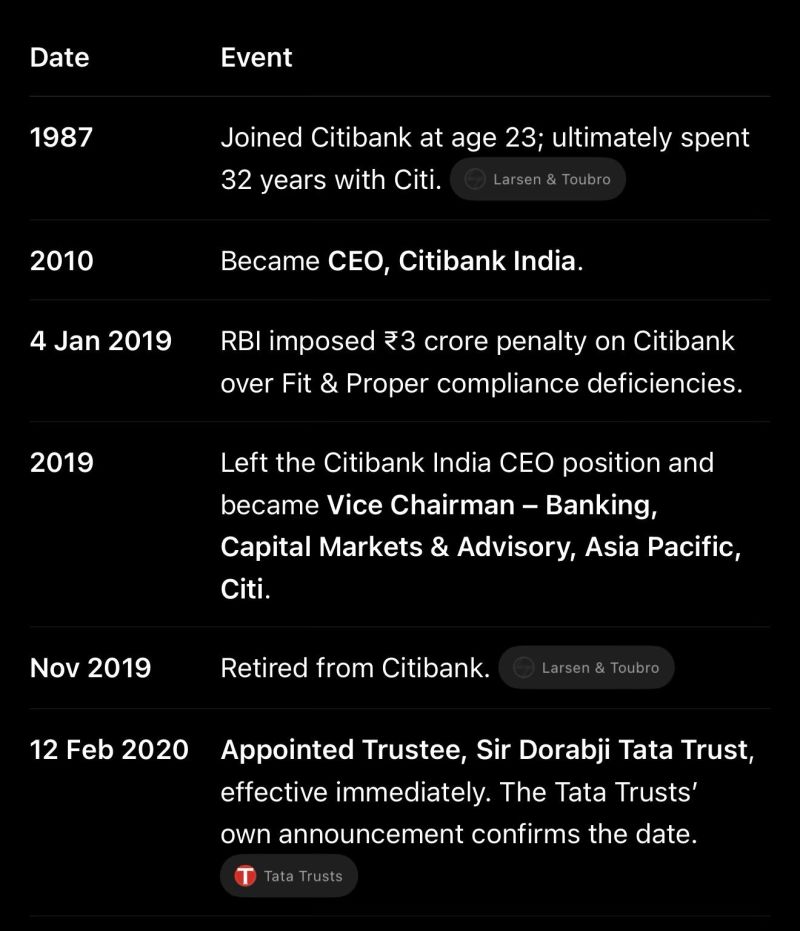
Before Venu did a Chandra, Tata Trusts had one more bad egg to deal with. A former head of a havala bank who was forced to resign by RBI. He was not considered fit and proper to continue. KYC problems etc are all polite language for saying they were opening benami accounts and indulging in havala.
Yet immediately after been barred and fined by RBI, the havala expert became of all possible options:
A Trustee of Tata Trusts.
An independent director of L&T
The karta dharta of HDFC
Out of 140 crore Indians, these three companies could only find this one individual.
A bigger question now is what services was he offering or had he offered in the past. Did he get blacklisted by RBI for services offered to these three.
Or rather to the three chiefs.