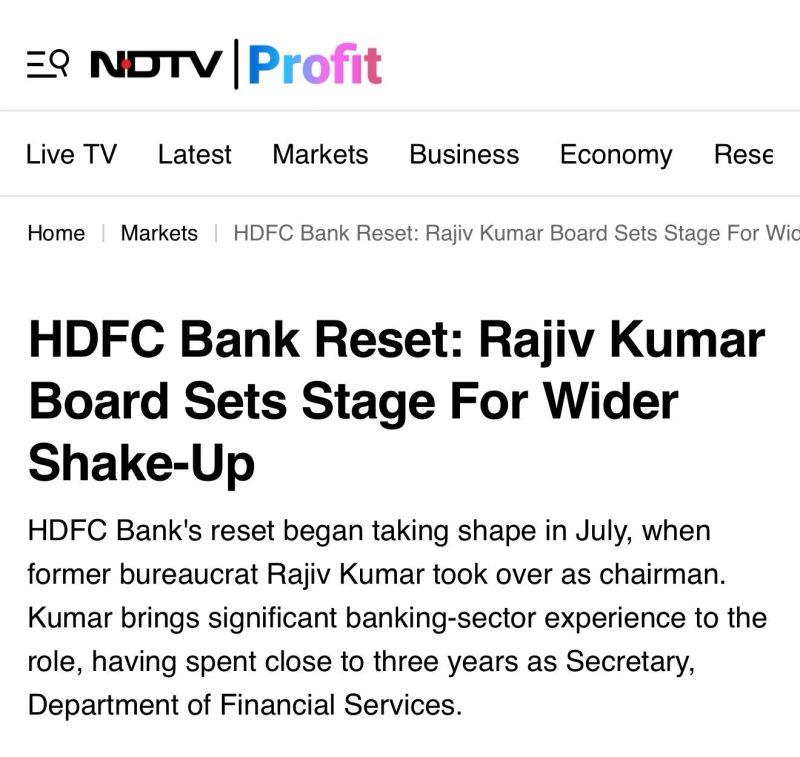
HDFC AND KOTAK BOTH SEE A CA BEING REPLACED BY AN IIT IIM IN THE CEO CHAIR. THIS ALONE WILL ELIMINATE 90% OF THE ISSUES.
The issue with both SNS at L&T and Chandra at Tatas is their lack of suitable education. Niether are IIT or IIM. Chandra which is now a verb more than a name is not even an engineer.
For nearly four decades, an abundance of global savings kept long-term borrowing costs low. Governments could accumulate debt, businesses could finance expansion, and investors could build portfolios around the assumption that capital would remain relatively cheap.
That era is ending.
The world wants to build again — AI infrastructure, data centres, semiconductor capacity, electricity generation, power grids, defence systems and resilient supply chains. But the same capital is now being asked to finance ageing populations, mounting government deficits and the energy transition.
The question is no longer simply where to invest. It is who will earn enough to justify the cost of capital. Legacy alone will do little. It doesn’t matter what your great grandfather achieved before you were born.
Consider AI. The investment opportunity is enormous, but the distribution of returns is uncertain. The companies building the infrastructure may not be the companies capturing the profits. And as hyperscalers increasingly turn to debt to finance their expansion, AI is becoming a credit-market story as much as an equity-market story.
An investor buying corporate bonds may unknowingly be taking a concentrated bet on the economics of AI.
Energy presents a similar paradox. Electricity demand is rising, grids are constrained, equipment is in short supply, and infrastructure takes years to build. These bottlenecks create opportunities — but only for businesses with durable competitive advantages, pricing power and the ability to execute.
Meanwhile, rising bond yields can mean two very different things. They may signal stronger growth and productive investment. Or they may reflect inflation fears and declining confidence in government finances.
The number on the screen can be identical. The investment implications are not.
It will demand granularity: understanding individual assets, the source of their cash flows, their financing structures and their ability to generate returns above the rising cost of capital.
For family offices, sovereign wealth funds and institutional investors, patient capital can be a decisive advantage. But patience alone is not a strategy. It must be combined with selectivity, diversification and the willingness to change course when the underlying economics change.
In a world where everyone wants capital, the scarce resource is no longer money. It is the judgement to commit it for the right reasons, at the right price, for the right duration. And that is where a IIT IIM type degree supersedes a CA type course.
#Investing#ArtificialIntelligence#PrivateCapital#FamilyOffices#EnergyTransition#CapitalMarkets#LongTermInvesting