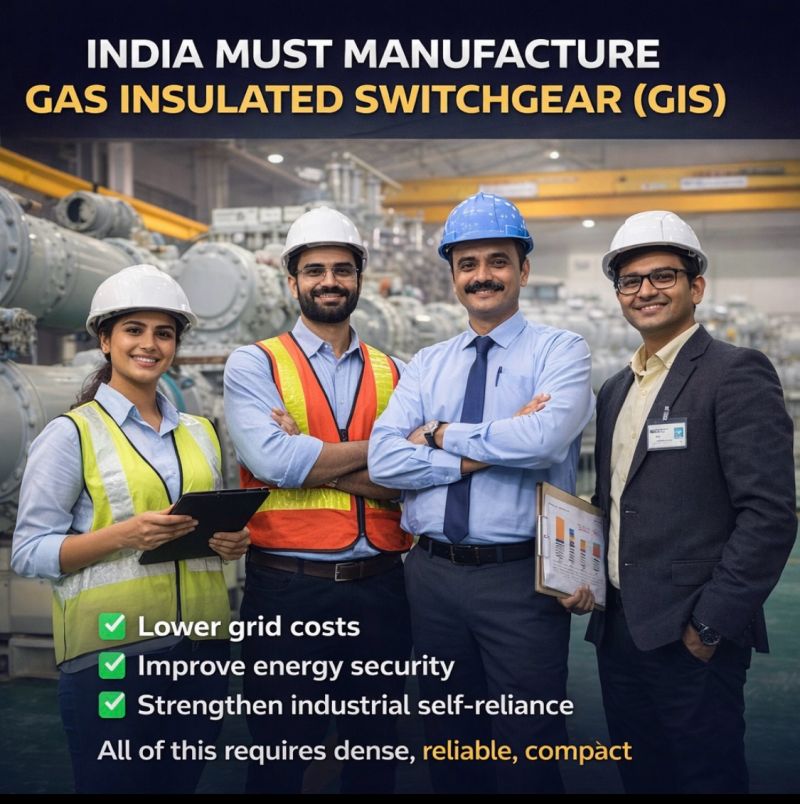
India’s electrification ambitions are limited by -The Grid. It still runs on 100 year old technology. With just two recent changes. Gas insulated switchgear (GIS) and digital transformers (DTs)
Forty years ago, I spent weeks around the countryside trying to understand the grid. My client was a French company called Merlin Gerin which had introduced SF6 circuit breakers in India. The current limit on a three phase wire is around 500 amps. So to carry more power you need more voltage. SF6 took voltage up to 400 KV. Now we are looking at 1200 KV and have already achieved 765 KV. The cost is still Rs 4 crore per km. But the constraint is finding the 250-300 acres of land required to build a switchyard at each tap point on the transmission grid. This is where the two new innovations come in – GIS and DTs.
• Reduces substation footprint by up to 90%
• Enables substations inside cities, underground, and inside buildings
• Provides far higher reliability due to sealed systems
• Makes offshore wind, solar parks, metros, and data centers viable at scale
Over the next decade, India will build:
• Massive renewable energy capacity
• Urban EV charging infrastructure
• Data centers and semiconductor fabs
• Metro systems across dozens of cities
All of this requires dense, reliable, compact substations – it requires GIS and DTs. Yet India still relies heavily on imports and foreign technology for both.
This creates three strategic risks:
1. Supply chain vulnerability during rapid grid expansion
2. High capital costs due to import dependence
3. Limited domestic capability in a core power infrastructure technology
India must treat both as strategic manufacturing infrastructure as these would:
• Reduce costs of grid expansion
• Improve energy security and allow a two way grid
• make power available at a low cost.
India is about to undergo the largest grid expansion in human history. 5 TW in five years. The world does not have the capacity to deliver GIS and DTs for such an offtake. Not in India. And not in China.
Market reality: GIS manufacturing is highly concentrated and DT is early stages.
Globally, ~80–90% of GIS market is dominated by 5 companies: Hitachi Energ, GE, Siemens Energy, ABB and Mitsubishi Electric
GIS manufacturing matters strategically. All credible Indian conglomerates have displayed extra-ordinarily poor foresight and strategic ability. This includes our bellwethers like the Tatas and L&T. They have got very busy chasing govt subsidies and cost plus businesses. Chasing stupidities which range from semiconductors (instead of solar) to contract manufacturing (for Apple !!!).
DT on the other hand is an innovation play.
In one week, $200M in venture funding landed on a single product category: the transformer.
DG Matrix ($60M Series A), Heron Power ($140M Series B), and Amperesand ($80M) are all betting that solid-state transformers — built on semiconductors like SiC and GaN instead of copper windings.