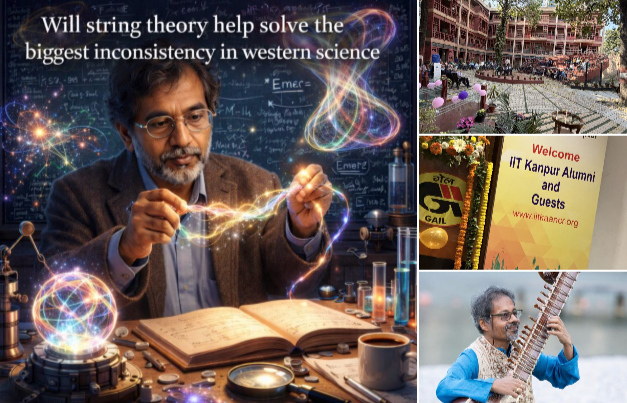
IIT Alumni meets are the ultimate superfood for a techies brain diet. This meet was also about a possible Nobel laureate I had not heard of. And string theory.
The six hour meets are pure adrenaline for the thinking brain. The last meet in Kanpur started with cold fusion and ended with ai for spatial awareness. I am still trying to digest what I learned. But in summary cold fusion can convert one element into another. Like iron into gold. And spatial awareness is how birds take off without colliding. These are not quacks but serious men (and women) of western science.
The meet in Delhi on Sunday was no less. I entered to see a paper Aadhar card capable of face recognition without any network link. Went on to see offline upi transfer using a feature phone. And then met the entrepreneur making an indian equivalent of zoom and WhatsApp.
And then inadvertently got sucked into a discussion on string theory – which could resolve the inconsistency between classical mechanics and quantum theory. It is the number one problem in the world of science to be solved. By leaps and bounds.
Someone casually mentioned a name:
Ashoke Sen.
I had never heard of him. My batchmate Ashanka Sen lives in Italy and plays the sitar which are the only strings I knew of. Both of them look almost identical.
I dug into Ashoke Sen :
• Theoretical physicist. String theory pioneer.
• No elite background. No powerful connections. Just intellectual depth.
• Studied at Presidency College, Kolkata.
• Masters from IIT Kanpur.
• Completed his PhD at Stony Brook University, USA.
He chose to return to India. While many chase better funding and visibility abroad, he worked quietly from Allahabad (now Prayagraj), at the Harish Chandra Institute of theoretical physics funded by the Dept of Atomic Energy.
He spent years working on problems most physicists considered unsolvable. At the time, string theory was controversial.
Colleagues doubted its relevance. Governments weren’t eager to fund it. Industry ignored it. Pretty much like cold fusion today.
He didn’t quit.
In 1994, he proposed a breakthrough idea called S-duality. It reshaped string theory.
Physicists believed there were multiple incompatible versions of the theory. His work showed they were different faces of the same deeper structure. What looked fragmented was unified. It triggered what scientists later called the “Second Superstring Revolution.”
He also made major contributions to understanding black hole entropy through string theory — tackling questions even Einstein couldn’t fully resolve. Eventually, the world noticed.
In 2012, he received the inaugural Fundamental Physics Prize — $3 million (₹35–36 crore at the time), one of the largest individual prizes in science. Three times the Nobel Prize.
Chosen among the greatest minds on Earth. A Padma Sri. A Padma Bhushan.
He never permanently left India. He proved that world-changing science does not require Silicon Valley, Harvard, or constant funding.