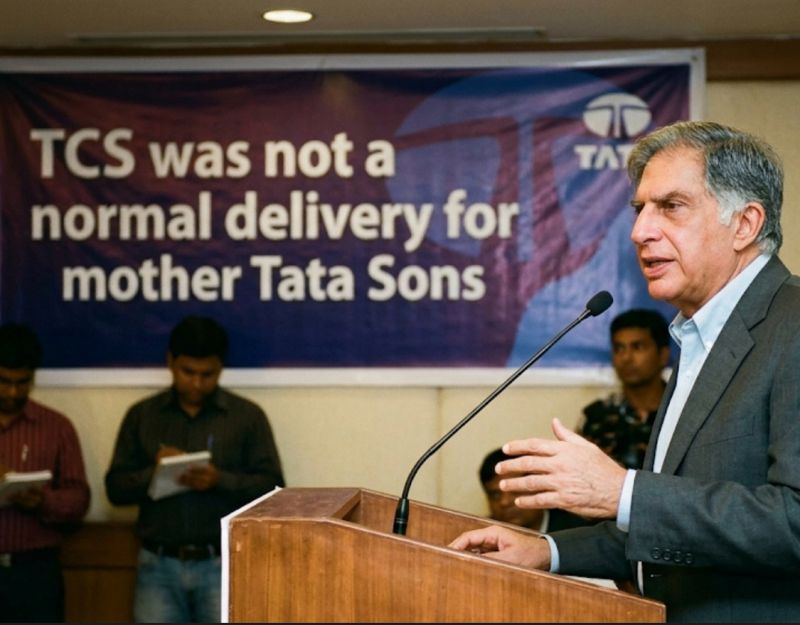
To understand Tata Sons and the genesis of its current condition, one has to understand its journey – both before and after childbirth. And the trials and tribulations it has gone through till it got here.
Firstly few realise that TCS was actually Tata Sons. In legal parlance, TCS was a proprietorship firm and Tata Sons was the proprietor. TCS was NOT a company as is now the case.
In 1968, when India barely had a software industry, Tata Consultancy Services began as a division inside Tata Sons. There were no unicorns, no startup ecosystem, no venture capital wave. Computers themselves were rare.
What existed instead was a long-term institutional vision. Under the leadership of J. R. D. Tata and operationally built by F. C. Kohli, TCS started by solving data processing and systems problems for Indian organizations at a time when the country was still deeply industrial and analog. For nearly three decades, TCS was not even a separate company. It functioned as part of Tata Sons until 1995, when it was incorporated as Tata Consultancy Services Limited.
That detail matters.
TCS was built patiently inside a larger institutions that could absorb uncertainty for decades.
TCS grew before the internet boom, before smartphones, before AI. Its rise was tied to something more fundamental:
the creation of technical talent, process discipline, global delivery capability, and institutional trust. The roots of that story go back to a small division created in 1968. It was located in Air India building at Nariman Point. And the two leaders who built it were FC Kohli and IITian Pawan Kumar.
In 1987 in that office, a graduate was hired to help Pawan Kumar with odd jobs. His name was Chandrasekhar. The graduate engineer trainees came from prestigious colleges. Being from IIT was kind of par for the course. TCS was not the only tech company. There were many. Tata Unisys. Tata IBM. Tata Honeywell. Tata Consulting engineers. Chandrasekhar was the only one in the group who was neither an engineer nor a MBA.
TCS struggled to morph into an independent company. The Companies Act required companies to disclose all kinds of things. For example they had to give the count and weight of their output. TCS struggled to comply with such onerous terms. Also there were all kinds of licenses required in those days. The simplest and actually only way out was to become a firm under some licensed company.
TCS didn’t make any money. It was a liability of sorts. Profitable companies would import equipment and sell them at a profit. Indians paid for hardware. No one was willing to pay for software. Software was hidden in hardware quotations. Services constituted an insignificant part of our agrarian economy – the other large heads being govt and industry.
After the failed ipo or Infosys in 1994, Tata Sons decided to hive off TCS into a separate company. This was not a normal birth. It had to be a Caesarian.
And that is where the issues started for Tata Sons.