Unless you build a new foundation.
Doing more of a wrong thing will not
Take us to the right thing.
AI has been around forever. The IIT Alumni Council has over a dozen fellows who have been teaching Ai for over 25 years.
What has happened suddenly to make it THE disruptor of our times.
Esp since there is no manufacturing process or material innovation involved. Remember Nvidia gets its chips made by commodity foundry fabs which have been around for a very long time.
ChatGPT is not end state. And everyone else is a copy of ChatGPT. Including Deep Seek. People do some tweaking and claiming but it is all the same. And everyone is limited by Kubernetes.
It is one thing to go from 95 nm to 9nm. But then the world stops at 0. Now after 5 or 6 nm, it is squeezing blood out of rock. Similarly you can’t run processors very much faster than 3 GHz. It will take too much power and come to a point of diminishing returns.
The key point the world misses out often is that there are things that move way faster than Moores Law. For example memory continues to get better. A new pen drive has more capacity than a one kg hard drive of some time ago. Similarly bandwidth gets better even faster than memory. Which is why you pay so little for a 5g mobile connection. In fact most of what you pay goes into govt levies or to cartelised profits.
Now Nvidia and OpenAI assume that they have to move as per Moores law which doesn’t make sense because you have reached the limit of silicon or are about to on all three fronts – track size, power consumption and frequency. Celestial ai and marvel are on the right path. As is POET.
The only option thus is to make the chip larger – an approach taken by Cerebras with massive chips. Or the more sensible approach of interconnecting a large number of chips together. The issue with doing that is that it takes a lot of power to move data at a very high rate even over short distances. So to add insult to stupidity – companies are trying to reduce that distance by packaging a large number of units vertically.
When you start with a faulty foundation, you can’t go very high and that is the conclusion everyone will come to. But incumbents can’t start all over. They would lose their comparative advantage. As well as their valuation.
And that is where India comes in.
We have no legacy. So we have no migration issue. We can build a new foundation which need not be one size which fits all. But is one that overcomes the shortfalls of the current systems.
The answer lies in a distributed compute stack which is connected by photons rather than electrons and which uses memory and bandwidth as substitutes for compute. It is a lot of work but is being done.
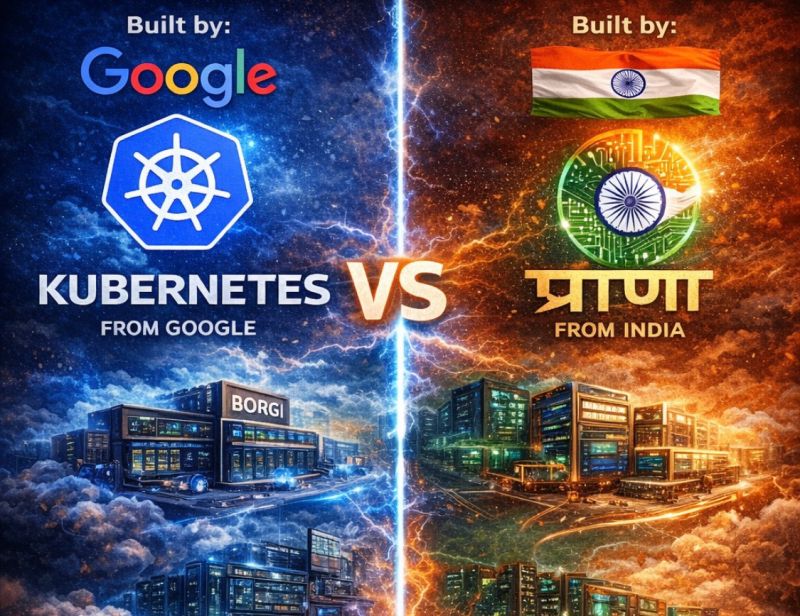
The indian middleware Praana is set to go live in beta shortly with a commercial release aimed at 15.8.27. And it should beat the living hell out of Kubernetes which everyone uses.
If you have a PhD against your name and are keen to debate, do message me.