For years the AI conversation has been dominated by large models running in massive cloud data centers.
I often joke that the Indian IT minister should be given the “salesman of the year” award by Nvidia for promoting their sales. Ai progress and becoming a meal ticket for Nvidias overpriced, easily replaceable chipsets doesn’t make good strategic sense for any country – unless Nvidia prices its chips at one fourth of where they are currently.
But jokes apart, I decided to personally tread another path. One that is Nvidia free – and this means no Nvidia GPUs and no CUDA, no Kubernet and nothing Nvidia. Nvidia is a brilliant company and it is concurrently building a castle and moat around it concurrently. And it is doing so because Jansen is an outstanding salesman who has equated a nations AI progress with buying Nvidia.
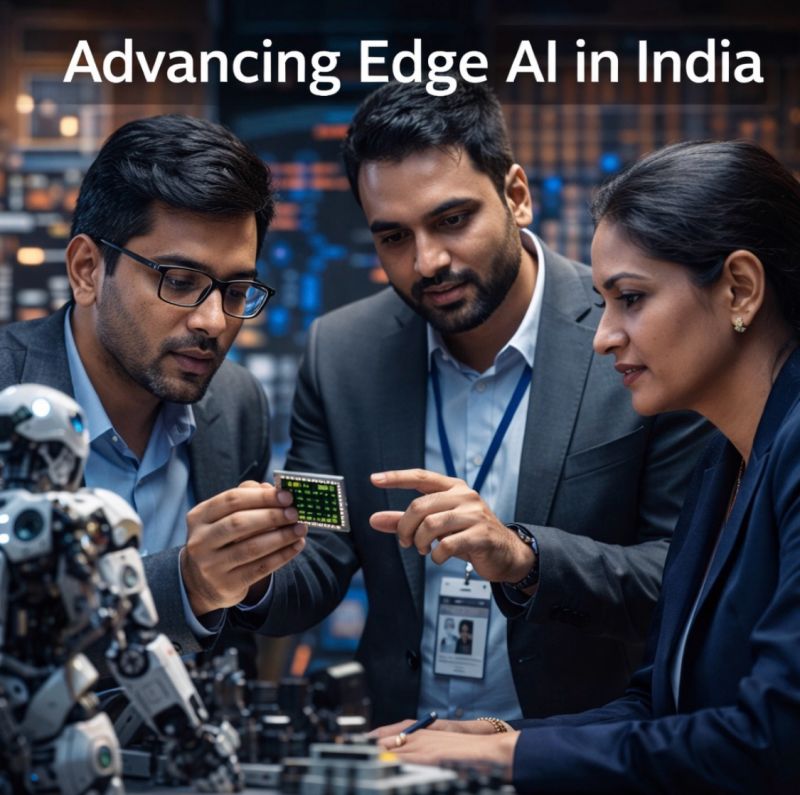
Over the past five years, I have been one of many orchestrating a shift that is now quietly happening — AI moving to the edge. Instead of sending data to the cloud, intelligence is now running directly on devices: robots, drones, industrial machines, cars, medical devices and even brain-computer interfaces. My batchmate Dr. Harrick Vin, the Global CTO of TCS taught me a nice word “neuromorphic computing”. Emulating the brain. No network required.
This is where companies like Taalas in Canada and Kodoy in India are becoming interesting. They are building purpose-built AI chips designed around specific neural networks, dramatically reducing power consumption and latency. They will soon redefine telco architectures. As I had posted before the AI summit – the phone has to become a thin edge AI. Elon Musk shared an identical view.
Alongside Taala and Kodoy, a new generation of edge-AI players is emerging all over – Canada and India are the hot spots: Nexus, Untether AI, Tenstorrent and Graphcore — all focused on pushing intelligence closer to where data is generated. I have spent the last two years promoting these startups in tier 3 and 4 cities. Cities you have never heard of. The startup is one individual with one device. Even the google pixel pro now has a gpu. Last week I flagged off five such startups in the Thar desert. I believe we will have a thousand neuromorphic ai startups in India. And they will collectively need maybe rs 5,000 cr. Something even the IIT Alumni Social Fund can do. Doesn’t need India AI Mission.
Why does this matter?
Because the next wave of AI will not live in chatbots. It will live in machines that act in the physical world — autonomous systems, smart infrastructure, defense technologies, and medical devices.
And those systems cannot wait for the cloud. They need intelligence at the edge.
The real AI race of the next decade may not be about who builds the biggest model — but about who builds the most efficient intelligence in the smallest possible device.
And I don’t think that someone is going to be the Nvidia open ai cartel.