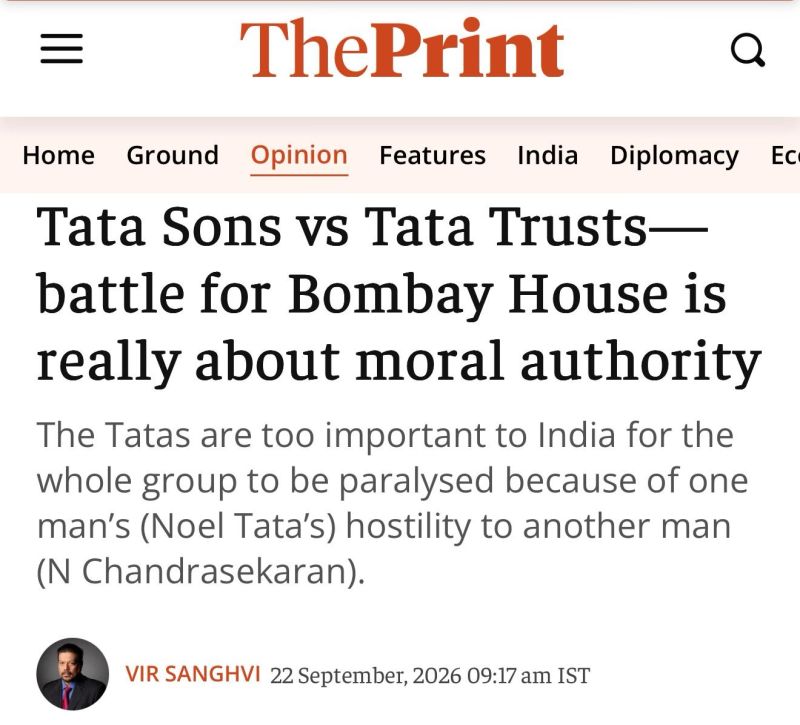
Tata Sons: When a Boardroom Becomes a Battle for Institutional Dharma
For more than 150 years, the Tata name has represented something larger than a business.
It represented trust.
Not merely trust as an asset on a balance sheet, but trust as an institution — an idea that capital can serve a purpose larger than capital itself.
That is why the developments inside Tata Sons deserve attention far beyond Dalal Street or Bombay House.
A reported confrontation within the boardroom raises a fundamental question:
Who is the custodian of an institution that belongs to no single generation?
The Tata structure is unusual.
The Tata Trusts sit at the heart of the ownership architecture. Tata Sons sits between the Trusts and the operating companies. The operating companies employ hundreds of thousands of people and touch millions of customers.
And yet, ultimately, these are governance structures created by human beings.
Which creates the real test.
Can the institution remain stronger than the individuals who temporarily control it?
That is the essence of Samarth Bharat.
A strong nation is not built merely by creating large companies.
It is built by creating institutions that survive their founders, their chairmen, their families, their factions and their crises.
Jamshedji Tata could not have known what TCS, Tata Motors, Air India or Tata Capital would look like a century later.
But he created something more valuable than a portfolio:
an institutional philosophy.
The danger for any great institution begins when governance becomes a contest between personalities rather than a conversation about purpose.
The Tata question therefore cannot simply be:
Who wins the boardroom?
The larger question is:
What happens to the institution after everyone in today’s boardroom is gone?
That is the measure of stewardship.
Not victory.
Not control.
Not even ownership.
Continuity.
India is entering an era in which its corporations will become increasingly important to national capability — technology, aviation, semiconductors, finance, defence, infrastructure and employment.
We therefore need Indian institutions capable of thinking in generations, not quarters.
Tata Sons is one of those institutions.
Its current tensions should therefore be viewed not merely as a corporate dispute, but as a test of something much larger:
Can India build corporate institutions whose governance is worthy of their national importance?
That is the real meaning of Samarth Bharat.
A prosperous India needs capital.
A powerful India needs technology.
But a Samarth Bharat needs institutions that outlive the people who run them.
The boardroom is temporary.
The institution must endure.
hashtag#SamarthBharat hashtag#IITAlumniCouncil hashtag#TataSons hashtag#TataGroup hashtag#CorporateGovernance hashtag#InstitutionBuilding hashtag#Leadership hashtag#Stewardship hashtag#India hashtag#IndianBusiness