Dilutional Refrigeration Water cooled chipsets Quantum, AI and cryogenic shipping
During the gold mining boom, it was the shovel makers who made hay whilst the sun shined. In the AI, quantum and cryogenics boom – it is going to be the air conditioner makers.
Quantum computers do not run on “normal” air conditioning. The qubit chip itself needs to be colder than interstellar space (10–20 mK), which is achieved with large dilution refrigerators (often 3–5 meters tall, costing $500k–$2M each). The room itself must be a highly stable, low-vibration, cleanroom environment with precision HVAC (±0.1–0.5 °C stability) and consumes tens to hundreds of kilowatts per system.
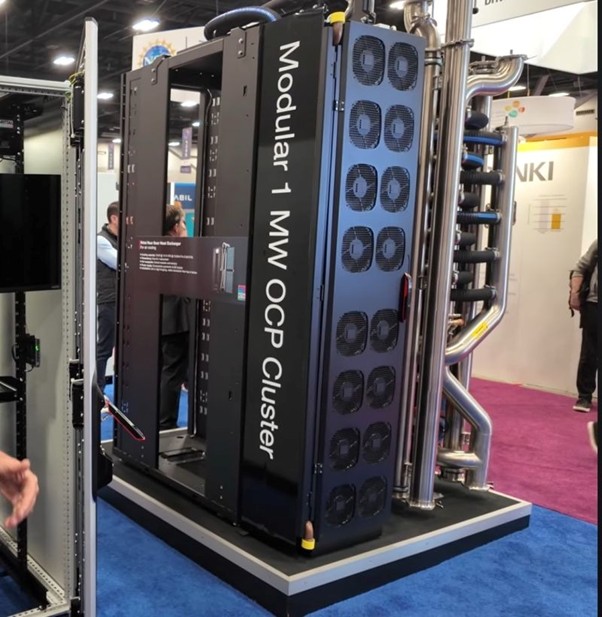
AI computing is going into neoclouds. These are racks in data centres which run GPUs and consume a humongous 150 kw of power per rack. At 60% efficiency, that is a heat load of 60kw per rack. Even if we manage 80% efficiency it is 30 kw per rack. Assume 10 sqft per rack and we are looking at 3 kw per square foot of data centre space. Akin to a large oven with its door open and heaters on at full power in every square feet. This will not cool using air convection. The heat will melt parts of servers. So we need water cooled systems. Each rack needs 400 gallons per hour of cooling systems.
The third market is cryogenics for shipping. Whether it is liquid natural gas being transported at -160 degC or liquid hydrogen at -260 degC – cryogenic refrigeration is hardly trivial. Special grades of stainless steel are required to make the tanks. Insulation quality is critical. Refrigeration failure can be catastrophic for a tanker with 100,000 tons of hydrogen or natural gas on board. And fire safety failure can cause unimaginable loss.
India is not a player in any of these markets as yet. There are three players in the fray. The largest and most credible is Amber Enterprises India Limited led by Jasbir Singh. They make the air conditioners for the Vande Bharat train and defence vehicles like the Sherp. They are also among the largest contract mfrs for air conditioners in the world. The other two are stealth mode startups which would not be fair to reveal. What is really divergent in these three is the approach. Whilst Amber is more traditional and is following the rankine cycle, the other two are following the Carnot cycle and the Brayton cycle. Of course the rankine cycle has to be complemented by the pulse tube refrigerator or the Stirling cryo cooler, it would suffice to say that these are all sufficiently black box technologies. New technologies give birth to new leaders.
I do not see a carrier, Voltas or hitachi succeeding in these three areas. L&T or Dosan have no chance. There will be new players and new challenges. These are high value mission critical niche markets. They are multi billion dollar markets which have come out of nowhere. Buyers are in a hurry to install. The manufacturers are hardly ready for prime time. You need these systems even if you are at the arctic circle.