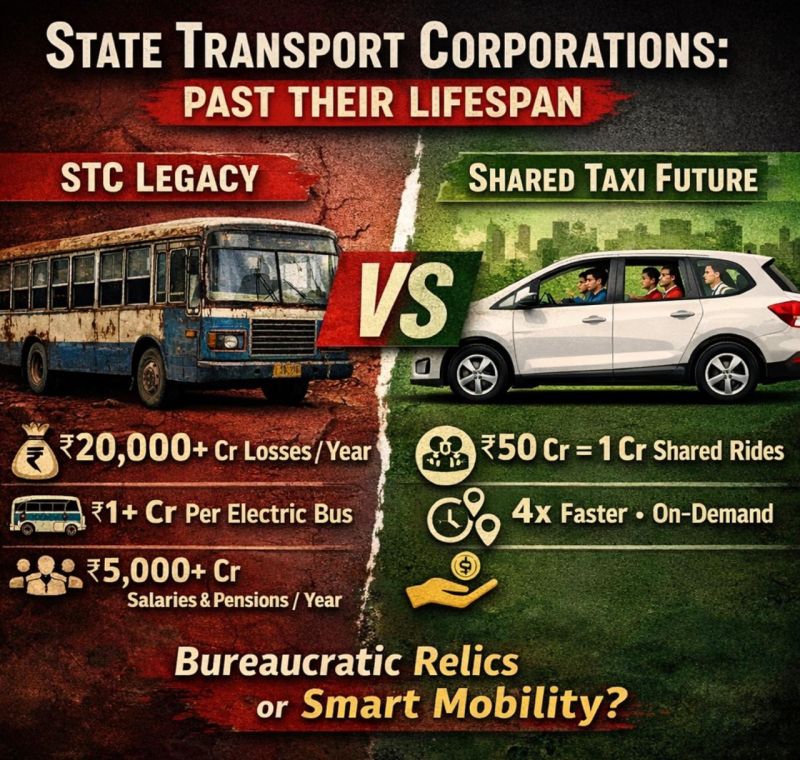
Attempts to revive STCs have failed.
Electric buses for intra city don’t work.
GCC type model didn’t work either.
Metro is ok – rest govt has to exit.
State Transport Corporations are India’s dead weight. The model of plying buses on fixed routes with fixed schedules does not meet the requirements and aspirations of the commuters. Today time is money and a cheaper option which takes longer, is inconvenient, uncomfortable or unreliable is probably not considered cost effective. Or even worthy of use.
Uber type taxis in shared mode can be both cheaper and more desirable to a bus service. For many bus service is a challenge. In electric buses, the floor is 900 mm above the road level and getting onboard for senior citizens or mobility challenged commuters is difficult. Changing buses involves a wait time which is more than the transit time. For the operator, driving a large bus needs a higher cost driver. Besides because of slow traffic, a lot of the battery gets consumed by the air conditioner reducing the range. There is considerable down time for charging and the buses are not safe.
It’s time to look at options outside of the STCs. Some indicators:
• Annual losses across STCs: ₹15,000–₹25,000 crore.
• Delhi DTC alone loses ~₹2,000–2,500 crore/year.
• Karnataka & Maharashtra STCs report similar multi-thousand-crore deficits.
• Electric buses cost ₹1.5 – 2 crore each. A cng bus would cost one third and do better on all fronts including pollution.
• Thousands have been purchased under PM E‑Drive, with thousands of crores in subsidies.
• Many run half-empty — billions of rupees locked in dead capital.
• Salaries and pensions: ₹5,000–10,000 crore annually.
• Hundreds of thousands employed, low productivity (<1 lakh passenger-km per staff per month).
Total: tens of thousands of crores every year wasted on fleets, depots, and jobs — not commuters.
Meanwhile, shared taxis could deliver tens of millions of rides at a fraction of the cost.
They are demand-driven, asset-light and Scalable instantly
The policy failure is clear: STCs are financially unsustainable, operationally obsolete, and structurally unreformable.
The solution:
1. Ban governments from subsidising STC operations
2. Repeal STC monopoly clauses.
3. Stop new STC capex immediately.
4. Legalise shared taxis, without permit caps.
5. Subsidise passengers, not vehicles.
A half-empty electric bus is not public service. A shared taxi moving four to seven people efficiently is.
Mobility is a network problem.
STCs are bureaucratic hierarchies.
And hierarchies don’t survive the internet.
The question isn’t whether STCs should go. It’s how long policy makers will pretend they work.
The PPP option hasn’t worked either. The STCs don’t like competition. Nor do private bus operators. New PPP companies don’t get subsidy. Nor do they get GCC vendors.
Ola and uber do perfectly fine without subsidy. There will be more like Rapido. Shared taxis can be enabled by transport ai.