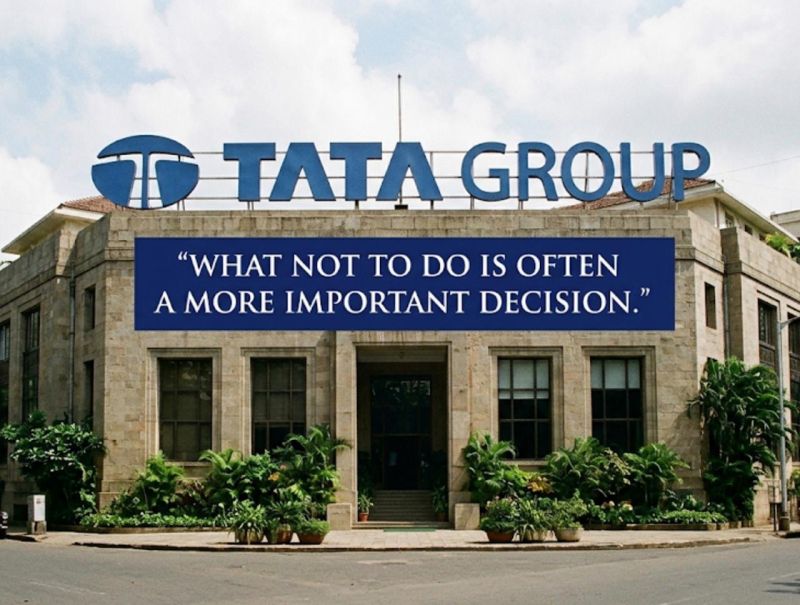
Most management thought is focused on “what to do ? How to do ? When to do ?”. The one thing I learned from JRD is, “What is it that we should not be doing ?”. I have found this framework to be very useful in evolving startup strategies. It is very easy to get lost in all kinds of activities which can be or should be avoided. When companies have capital or get funded – they are deluged with schemes and proposals from all kinds of entities wanting to use that money to further their own business case.
Those flooding you will range from overpriced professionals to global multinationals looking for sucker investors to act as their contract manufacturers, country distributors etc.
The biggest failing of the Tata Group from 1991 to 2021 (three decades of value destruction) has been to get suckered into such schemes. The Tatas had no reason to further the business of Starbucks in India when they had their own Taj Hotels. Similarly they had no reason to tie up with IBM or for that reason with Apple. Tatas cannot be acting like traders, middlemen, liaison agents or worse “fixers”. So of course you will have Pramit Jhaveri as a trustee and Nira Radia as strategy advisor … and then it progressively gets worse. This has been the biggest and actually only real failing of the group in these three decades. The quest for reducing uncertainty by investing in other people’s brand in preference to building their own. And shying away from investing in innovation and research. Where every road is paved with gold. Let me take one example of what Tata should not be doing.
Tata Electronics
Electronics manufacturing is fundamentally different from the businesses where the Tata Group historically built dominance. Businesses like TCS, Titan or Trent generate strong returns through brands, software capability, distribution, customer relationships and operating leverage.
Semiconductor and electronics manufacturing operate on a completely different economic model: brutal capex cycles, wafer-scale precision, geopolitical dependency, thin margins and relentless technology obsolescence.
Countries that succeeded in electronics manufacturing built deep ecosystems over decades. Taiwan created an entire semiconductor supply chain around TSMC. South Korea, China … decades at work.
For Tata, the danger is not failure which they may afford. The danger is opportunity cost. This they can’t afford.
Every ₹10,000 crore deployed into low-return manufacturing is capital cannot be deployed into higher-return sectors where the group already has structural advantages
Another challenge is that electronics manufacturing rarely creates durable moats unless the company owns core IP, process leadership or ecosystem control.
This move risks turning the group into a state-aligned, subsidy begging entity rather than a high-return private-sector allocator of capital.
Sometimes the strongest strategy is knowing what not to do. True for company and country.